 Available in US
Live odds comparison, form guides, trap analysis and betting strategies for UK greyhound racing.
What Is a Greyhound Odds Checker and Why Every UK Punter Needs One
Greyhound odds vary wildly between bookmakers — sometimes by margins that turn losers into winners. A six-runner race at Romford on a Tuesday night might show trap four at 5/1 with one firm and 7/1 with another. Stake a tenner on the shorter price and you collect sixty pounds. Take thirty seconds to check the longer price and you collect eighty. Same dog, same race, same result — twenty quid difference. That is the core argument for using a greyhound odds checker before every single bet you place on the dogs.
A greyhound odds checker is a comparison tool that pulls live prices from multiple licensed UK bookmakers and displays them side by side for each runner in a race. Instead of logging into three or four separate accounts, scrolling through race cards and mentally noting who is offering what, the checker does it in one screen. The important thing is that it gives you a snapshot of the entire market in real time, and in greyhound racing — where markets are thin and move fast — that snapshot can be worth more than any tip sheet.
Greyhound odds checker: A tool that compares betting prices from multiple bookmakers for every runner in a greyhound race, allowing punters to identify the best available odds before placing a bet. Studies of greyhound markets consistently show price discrepancies of 10 to 25 percent between the best and worst odds on the same dog in the same race.
Why does this matter more for greyhounds than, say, Premier League football? Greyhound betting markets are smaller and less liquid. Bookmaker traders spend less time pricing up a Tuesday BAGS meeting at Romford than they do a Champions League semi-final, which means the prices are rougher and the gaps between firms wider. Greyhound racing also happens fast — races are over in roughly thirty seconds, and the cards run every fifteen minutes at some tracks. If you are betting on five or six races in an evening, those small percentage gains compound quickly.
The UK greyhound betting market remains significant. According to the Gambling Commission, off-course dog racing turnover runs into the hundreds of millions annually, and that figure does not include on-course tote pools or the exchange markets. With eighteen GBGB-licensed stadiums running cards almost every day of the year, the volume of betting opportunities is enormous. An odds checker helps you navigate that volume without drowning in it.
How Greyhound Racing Odds Work in the UK
British greyhound odds follow the same fractional format as horse racing, but the margins work differently. Every set of odds represents two things: the bookmaker's assessment of a dog's chance of winning, and the bookmaker's built-in profit margin. Understanding both is the foundation of intelligent betting.
When a bookmaker prices up a six-trap race, they assign each dog a probability of winning. If they were fair, those probabilities would add up to 100 percent. They never do. The total always exceeds 100 percent, and the difference is the margin — sometimes called the overround.
Overround — the percentage by which a bookmaker's implied probabilities exceed 100%. A six-runner greyhound race with a 120% book means the bookie has built a 20% margin into the prices. Lower overrounds mean better value for the punter.
Greyhound overrounds tend to be higher than those in horse racing, partly because the markets attract less money and partly because casual punters are less likely to shop around. A typical BAGS meeting might carry an overround of 125 to 135 percent, while a major open race might tighten to 115 to 120 percent. That gap is precisely why odds checking matters. Odds also reflect information — when a price shortens, money is being placed; when it drifts, the opposite applies. Different bookmakers hold different opinions, and those differences create opportunity.
Understanding Fractional Odds
Fractional odds remain the default format in UK greyhound racing. They work exactly as the name suggests: the first number tells you the profit relative to the second number, which represents your stake. At 5/1 (read "five to one"), a one-pound stake returns five pounds in profit plus your original pound back — six pounds total. At 7/2, a two-pound stake returns seven pounds profit, so a one-pound stake returns three pounds fifty in profit plus your stake.
The fractions below evens trip people up. At 4/6, you need to stake six pounds to win four. It looks unattractive, but it reflects a dog that the market considers more likely to win than to lose. Evens — written as 1/1 or simply "Evs" — means the market gives the dog a roughly fifty-fifty chance.
Converting fractional odds to implied probability is straightforward. Divide the right-hand number by the total of both numbers. At 3/1, the implied probability is 1 divided by 4, or 25 percent. At 6/4, it is 4 divided by 10, or 40 percent. This conversion is essential for value betting — if you believe a dog has a 30 percent chance but the odds imply only 20 percent, you have found an overlay. You will also see prices like 11/4, 9/2 and 11/8 rather than the rounded figures common in football, because greyhound markets are more granular with smaller fields and tighter distinctions between runners.
Decimal Odds Conversion
Decimal odds are increasingly popular on betting exchanges and with European-facing bookmakers. The format is simpler than fractional: the number represents the total return for every pound staked, including your stake. Decimal 4.00 means four pounds back for every pound bet — three pounds profit plus the original stake. It is equivalent to 3/1 in fractional terms.
The conversion formula is clean. Take the fractional odds, divide the first number by the second, and add one. So 5/2 becomes (5 / 2) + 1 = 3.50. Going the other way — decimal to fractional — subtract one and express the result as a fraction. Decimal 2.75 minus one gives 1.75, which is 7/4.
Where decimal odds genuinely help is in comparing value across multiple runners and calculating accumulator returns. Multiplying decimals together gives you the combined odds instantly — no converting fractions to a common denominator. If you are building a double at 3.50 and 2.20, the combined decimal is 7.70. Stake five pounds and the return is thirty-eight pounds fifty. Try doing that quickly with 5/2 and 6/5.
Trap 3 — Ballymac Dorado
Fractional: 7/2 | Decimal: 4.50
Stake: £10
Fractional return: (7 / 2) x £10 = £35 profit + £10 stake = £45 total
Decimal return: 4.50 x £10 = £45 total
Same result, different route. Decimal is faster for mental arithmetic.
Starting Price vs Early Price
The starting price is the official odds returned on a greyhound at the moment the traps open. It is determined by on-course market movements and serves as the default settlement price when no fixed odds have been taken. If you place a bet "at SP," you accept whatever price the market arrives at by race time.
Early prices changed the dynamic. Most online bookmakers now display fixed odds from the moment the card is published, sometimes hours in advance. Take that price and it is locked in — whether the dog shortens to favourite or drifts to 10/1 before the off, your payout is based on the price you took. If you spot a dog at 6/1 early in the day and the market hammers it down to 3/1, you have doubled your potential return. Conversely, if you take 3/1 and the dog drifts to 8/1, you have locked in a poor price.
This is where best odds guaranteed enters the picture. BOG — offered by several UK bookmakers on greyhound racing — guarantees you the higher of the price you take and the starting price. If you back a dog at 4/1 and it goes off at 6/1, you get paid at 6/1. If it shortens to 2/1, you keep your 4/1. It removes the downside of early-price betting entirely. Taking early prices with a BOG bookmaker is almost always preferable to betting at SP, because you capture the upside of both scenarios.
How to Compare Greyhound Odds Across Bookmakers
The difference between backing a 5/1 winner at one bookie versus 4/1 at another is pure profit left on the table. It sounds obvious, yet the majority of casual greyhound punters never check a second price. The problem is not laziness — it is that most people underestimate how frequently and how significantly odds diverge on greyhound racing compared to more mainstream sports.
In a Premier League football match, the top bookmakers might differ by a penny or two on the decimal odds. In a greyhound race, the gap between the best and worst price on the same dog can be a full point or more on fractional odds. Greyhound markets are priced by fewer traders, attract less volume, and move on smaller amounts of money. A single large bet can shift a dog's price at one firm without moving the market elsewhere, creating pockets of value that exist for minutes at a time.
Typical Greyhound Overround
125–135%
Overround on Open Races
115–120%
Avg. Price Gap Between Best/Worst
15–25%
BOG Bookmakers on Dogs
4–6 firms
The process is simple. Before placing any bet, pull up an odds comparison tool and check the prices across at least four or five bookmakers. Identify the best price. Confirm that the bookmaker is licensed by the UK Gambling Commission. Place the bet. It adds perhaps thirty seconds to your workflow. Over the course of a year, those thirty seconds per bet can translate to hundreds of pounds in additional returns.
Odds Comparison Tools and Websites
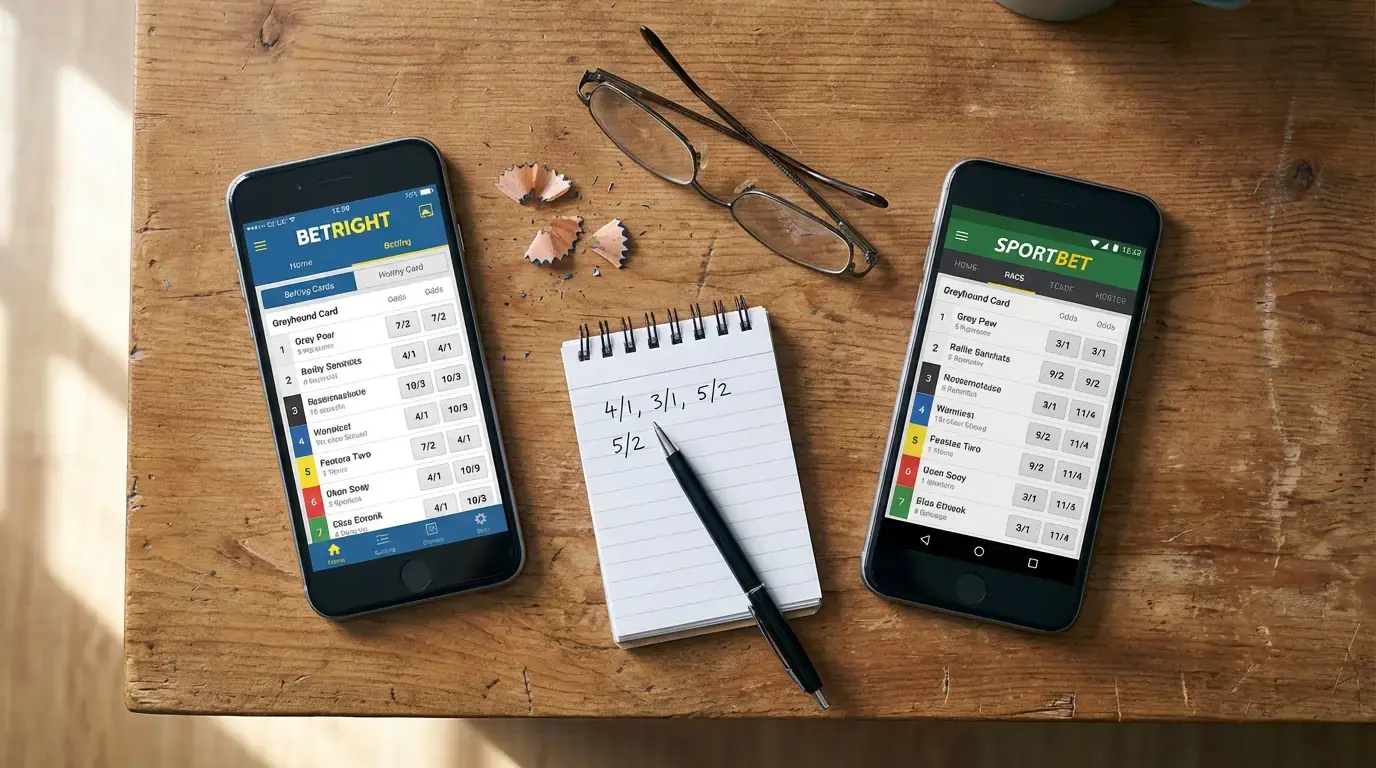
Several platforms serve the UK greyhound market, though they vary in coverage, speed and reliability. The dominant player is Oddschecker, which aggregates prices from most major UK bookmakers and updates in near real-time. Its greyhound section covers BAGS meetings, evening cards and the big opens, with market mover tracking that highlights dogs whose odds have shortened significantly.
Oddschecker
Widest bookmaker coverage for UK greyhounds. Real-time odds updates, market mover alerts, and ante-post markets for major events like the English Greyhound Derby. Free to use.
OddsDigger
Multi-bookmaker aggregator with a clean comparison layout. Covers daily BAGS meetings and evening cards. Slightly fewer firms than Oddschecker but a useful second opinion.
BettingOdds
Odds comparison tables paired with betting guides and bookmaker reviews. Solid greyhound coverage with additional educational content on bet types and strategy.
Beyond the aggregators, Timeform provides detailed form data alongside its odds, and the Racing Post's greyhound section offers race cards, tips and odds comparison tables. One word of caution: no aggregator is perfect. Prices can lag by a few seconds, and in a fast-moving greyhound market, a few seconds matters. Always confirm the price at the bookmaker's own site before clicking "place bet."
When to Check Odds: Timing Your Bet
Greyhound markets follow a predictable rhythm. Early prices appear when the card is published — sometimes the morning of the meeting. At this stage, odds are wide and the overround is at its highest. Bookmakers are cautious because they have had little time to assess where the money will flow. The upside of betting early is that you occasionally catch a generous price before the market corrects. The downside is that fewer firms may have priced the race.
As the race approaches — particularly in the final thirty to sixty minutes — prices tighten. More bookmakers enter the market, more money arrives, and the odds begin to reflect a truer picture. This is the sweet spot for comparison. The prices are more meaningful and the choice of firms is wider.
In the final two to three minutes before the off, things can move sharply. A sudden shortening might indicate late money from connections. A drift might mean a dog has not looked right in the warm-up. If you have best odds guaranteed, these last-minute movements work in your favour regardless. The general rule: check odds early to identify potential value, then confirm and place your bet in the final fifteen to twenty minutes when the market has settled.
Build the book yourself
You know how odds are built and where to find the best ones. Now it is time to decide what to do with them.
Greyhound Bet Types: From Singles to Tricasts
Six runners. Thirty seconds. Dozens of ways to bet. Greyhound racing may look simple — six dogs chase a hare around an oval — but the betting menu is surprisingly deep. From straightforward win bets to complex combination tricasts, the range of wagers available on a single race gives punters the ability to tailor their approach to their own risk tolerance, knowledge level and bankroll.
The most important thing to understand is that not every bet type suits every situation. A win single on a strong favourite in a weak BAGS race is a different proposition entirely from a tricast on a competitive open race at Nottingham. Matching the right bet type to the right race is a skill in itself, and it starts with understanding what each option actually involves, what it pays, and when it makes sense to use it.
Note: Not all bookmakers offer every bet type on every greyhound race. Forecast and tricast markets are sometimes unavailable on smaller BAGS meetings, and each-way terms can vary between firms. Always check the specific market availability at your chosen bookmaker before building your bet.
Win, Place and Each Way Bets
A win bet is the simplest wager: pick a dog, stake your money, and if it crosses the line first, you get paid at the agreed odds. If it finishes anywhere else, you lose your stake. For most punters on most races, this is the bread and butter.
A place bet pays out if your dog finishes in one of the designated places — usually first or second in a six-runner greyhound race. The odds for a place bet are a fraction of the win odds, typically one quarter. A dog at 8/1 to win would be 2/1 for a place. The payoff is smaller, but the probability of collecting is significantly higher.
Each way combines both: two bets in one. Half your stake goes on the win, half on the place. If the dog wins, you collect on both. If it finishes second, you lose the win portion but collect on the place. The total stake is double — a five-pound each way bet costs ten pounds. Each way tends to offer best value on mid-priced dogs in the 4/1 to 8/1 range, where the dog is live for the win and likely to place if things do not go perfectly. On short-priced favourites, the place return barely covers the total outlay.
Forecast and Tricast Betting
A straight forecast requires you to predict the first and second finishers in the correct order. A reverse forecast covers both permutations and costs double the stake. Tricast betting extends this to three dogs — first, second and third in order. The payouts reflect the difficulty: a successful tricast on a competitive race can return fifty or a hundred times your stake. Combination tricasts cover all six orderings and cost six times the unit.
Forecast and tricast dividends are typically calculated by the Computer Straight Forecast or Computer Tricast formula, which uses the starting prices of all runners. This means the dividend is not fixed when you place the bet. Some bookmakers offer fixed-odds forecasts where you know the return in advance, but these tend to pay less than the CSF dividend on average.
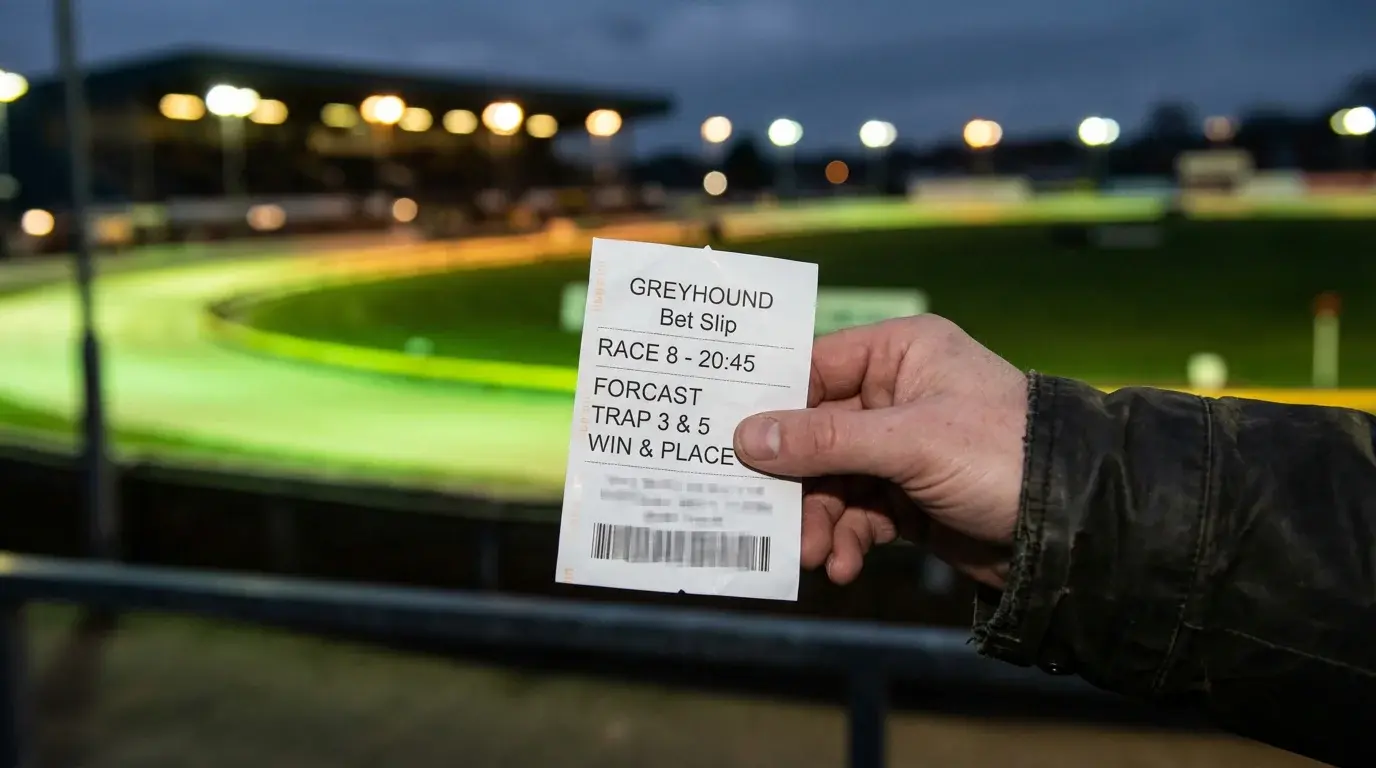
Straight Forecast Calculation Example
Race at Monmore Green, 480m graded race.
You predict: Trap 1 first, Trap 4 second. Stake: £2 straight forecast.
Result: Trap 1 wins at SP 3/1. Trap 4 finishes second at SP 5/1.
The CSF dividend is calculated algorithmically using all six runners' SPs. In this scenario, the computer forecast might return £18.40 to a £1 stake.
Your return: £18.40 x 2 = £36.80 from a £2 outlay.
Accumulator Bets on Greyhounds
An accumulator combines two or more selections into a single bet where the winnings from each selection roll onto the next. A double covers two selections, a treble covers three. Every selection must win for the bet to pay out. Greyhound accas are popular because the sport's quick-fire nature means you can build and settle a four-fold in under an hour.
The odds compound rapidly: a double on two 3/1 shots returns 15/1 in fractional terms. A treble on three 3/1 selections returns 63/1. The returns look thrilling. The reality is that stringing together three or four greyhound winners in a row is genuinely difficult. If you build accas, limit the legs — doubles and trebles are more realistic than five-folds — and focus on races where you have a strong opinion rather than adding legs to inflate the price. Check whether your bookmaker offers acca insurance on greyhounds, as some firms return your stake as a free bet if one leg lets you down.
Trap Bias and Draw Analysis
The strip of sand between trap one and the rail decides more greyhound races than form ever will. Across UK greyhound tracks, the trap draw has a measurable, statistically significant impact on win rates. At some tracks, trap one wins 30 percent more races than trap six over a full calendar year. Ignoring this information is like betting on horse racing without checking the going.
The reason trap draw matters so much is physics. Greyhound tracks are ovals, and the first bend arrives within a few seconds of the traps opening. Dogs on the inside have a shorter run to the bend and can tuck onto the rail early, saving ground through every turn. Dogs on the outside cover more distance and risk getting squeezed wide. The extent of this advantage depends on track configuration, which is why trap bias varies from venue to venue.
For the odds-checking punter, trap analysis helps you assess whether a dog's price accurately reflects its draw. A dog at 3/1 from trap one at a strongly rail-biased track might be better value than a dog at 5/1 from trap six. When the public bets on form and ignores trap statistics, the market misprices draw advantage — and mispricings are where value lives.
What Is Trap Bias?
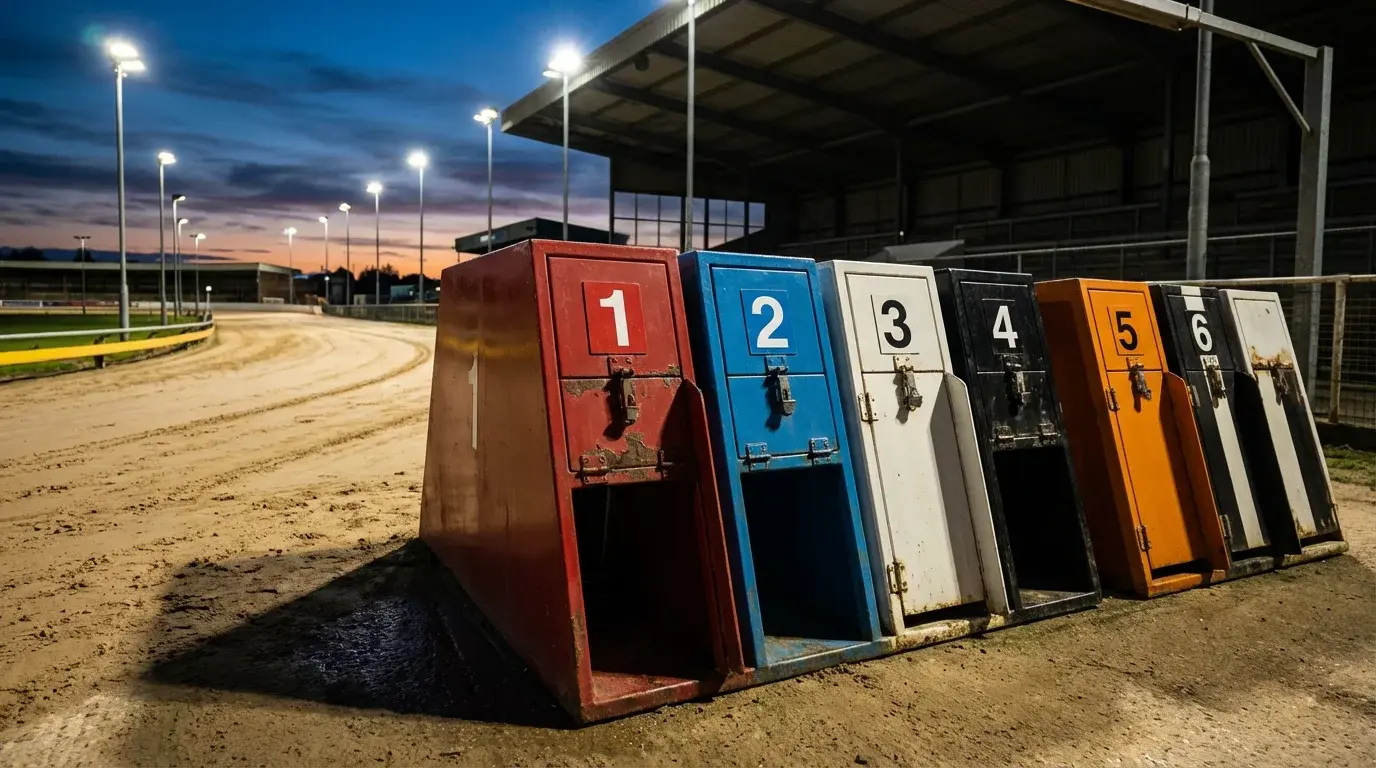
Trap bias is the statistical tendency for certain traps to produce more winners than others at a given track. It is driven by track geometry — the angle of the first bend, the length of the run to it, the position of the hare rail, and the camber of the surface. A track with a tight first bend close to the traps heavily favours inside runners. A track with a long straight before the first bend dilutes that advantage because all six dogs have time to find their stride.
The standard numbering runs from one (closest to the rail) to six (furthest). At most UK tracks, traps one and two show a win-rate advantage over traps five and six, but the magnitude varies. Romford's tight layout gives trap one a pronounced edge. Towcester, with its wider bends, shows a milder bias where middle traps compete effectively.
Seeding complicates the picture. Racing managers assign dogs to traps based on running style. Confirmed railers go in traps one or two; wide runners go in five or six. This means trap bias and running style are deliberately correlated. A high win rate for trap one does not mean the trap is inherently lucky — it partly means rail-suited dogs are placed there. The skill is separating the track effect from the seeding effect, which requires examining samples where dogs have raced from multiple traps.
Track-by-Track Trap Statistics
Trap win rates are publicly available through form databases and track-specific statistics pages. The numbers fluctuate season to season — track maintenance, weather patterns and hare rail changes all affect bias — but broad tendencies remain stable.
Romford, a compact sprint track, historically shows a strong inside bias. Trap one and two account for a disproportionate share of winners, reflecting the tight first bend. Nottingham's longer circuit and wider bends produce a more balanced profile where traps three and four often perform well. Monmore Green favours trap one at shorter distances but levels out over 480 metres. Towcester has a sweeping layout where early pace matters as much as trap draw. The 2025 Derby final illustrated this: Droopys Plunge won from trap one, but the favourite Bockos Diamond ran competitively from the widest box.
The practical application: before betting, check trap statistics for the specific track and distance. If trap one wins 22 percent of races (above the 16.7 percent expected from a fair six-runner field) and the dog drawn there has reasonable form, the market may be underpricing the draw advantage.
Reading Greyhound Form Like a Pro
A greyhound's race card tells a story — if you know how to read it. Every line of form contains compressed data about how a dog ran, where it ran, from which trap, over what distance, and in what time. Stringing those data points together across a dog's last four or five outings gives you a picture of its current ability, fitness trajectory and preferences. The punters who read form well do not necessarily pick more winners than casual bettors. They avoid more losers — and in the long run, that distinction matters more.
Greyhound form is arguably more interpretable than horse racing form because the variables are fewer. There is no jockey, no weight allocation, no going changes as dramatic as soft-to-firm. The dog either ran well or it did not, from a specific trap, around a specific track, in a specific time. The key is knowing which pieces of information to prioritise and which to discount.
Key elements of a greyhound race card: dog name, trainer, trap number, weight, form figures (last six runs), best recent time, sectional split time, grade, distance, track, comments (running narrative from previous races such as "led to line" or "crowded first bend").
Race Card Basics
The form figures are the starting point — a string of numbers representing finishing positions in the dog's most recent races, reading left to right from oldest to most recent. A sequence like 211132 tells you this dog has been consistently competitive. A sequence like 654465 paints a different picture. But raw finishing positions do not tell the full story.
The comments column matters. A dog that finished fourth but was recorded as "crowded first bend, ran on well" had bad luck, not bad form. A dog that finished second with "led to run-in, caught close home" was likely the best dog in the race. Reading the narrative alongside the numbers separates informed analysis from surface-level pattern recognition.
Grade tells you the level of competition. GBGB races run from A1 (highest) through to A10 or lower. A dog dropping in grade faces weaker opposition, improving its chance. A dog raised in grade faces tougher company. Grade changes are among the most undervalued form factors by casual punters.
Sectional Times and Early Pace
Sectional times measure how quickly a dog reaches a specific point on the track, usually the first bend. In greyhound racing, early pace is arguably the single most predictive metric because the first bend is where most races are won or lost. A dog that consistently posts fast sectionals will reach the bend in front, claim the inside rail, and save ground through every subsequent turn.
Sectional times are published on race cards, typically measured to the hundredth of a second. Comparing sectionals across different tracks is meaningless because configurations vary, but within a single track and distance they are directly comparable and enormously valuable. When two dogs have similar overall times but one consistently posts faster sectionals, that dog is likely to lead into the first bend. Combined with a favourable trap draw, this makes it a strong proposition.
One important caveat: track surfaces and weather affect running times. A wet track runs slower than a dry one. Comparing a 28.50 run on a damp night with a 28.20 on a dry card and concluding the second dog is faster is misleading. The best form readers contextualise times by conditions, building a mental database of what constitutes a strong time for each track in different weather.
Best Greyhound Betting Sites for Odds
Not all bookmakers treat greyhounds equally — some barely acknowledge the sport exists. Open certain apps and you will find comprehensive football, detailed horse racing cards, and a greyhound section that feels like an afterthought. For anyone who takes dog racing seriously, the quality of the bookmaker matters as much as the quality of the dog.
The best greyhound bookmakers price up races early, offer best odds guaranteed as standard, stream races live, cover all GBGB tracks including smaller BAGS meetings, and process payouts without friction.
Bet365
Extensive greyhound coverage including live streaming of most UK and Irish meetings. Early prices available. In-play betting on selected races. Widely regarded as one of the strongest all-round greyhound bookmakers.
Boylesports
Consistent best odds guaranteed on greyhounds. Acca boosts and BOG promotions. Good coverage of Irish tracks alongside full GBGB schedule. Popular with dedicated dog racing punters.
Paddy Power
Strong greyhound interface with live streaming, race cards and tipping content. Regular promotional offers on dog racing. Comprehensive market coverage including forecast and tricast options.
What Makes a Good Greyhound Bookie?
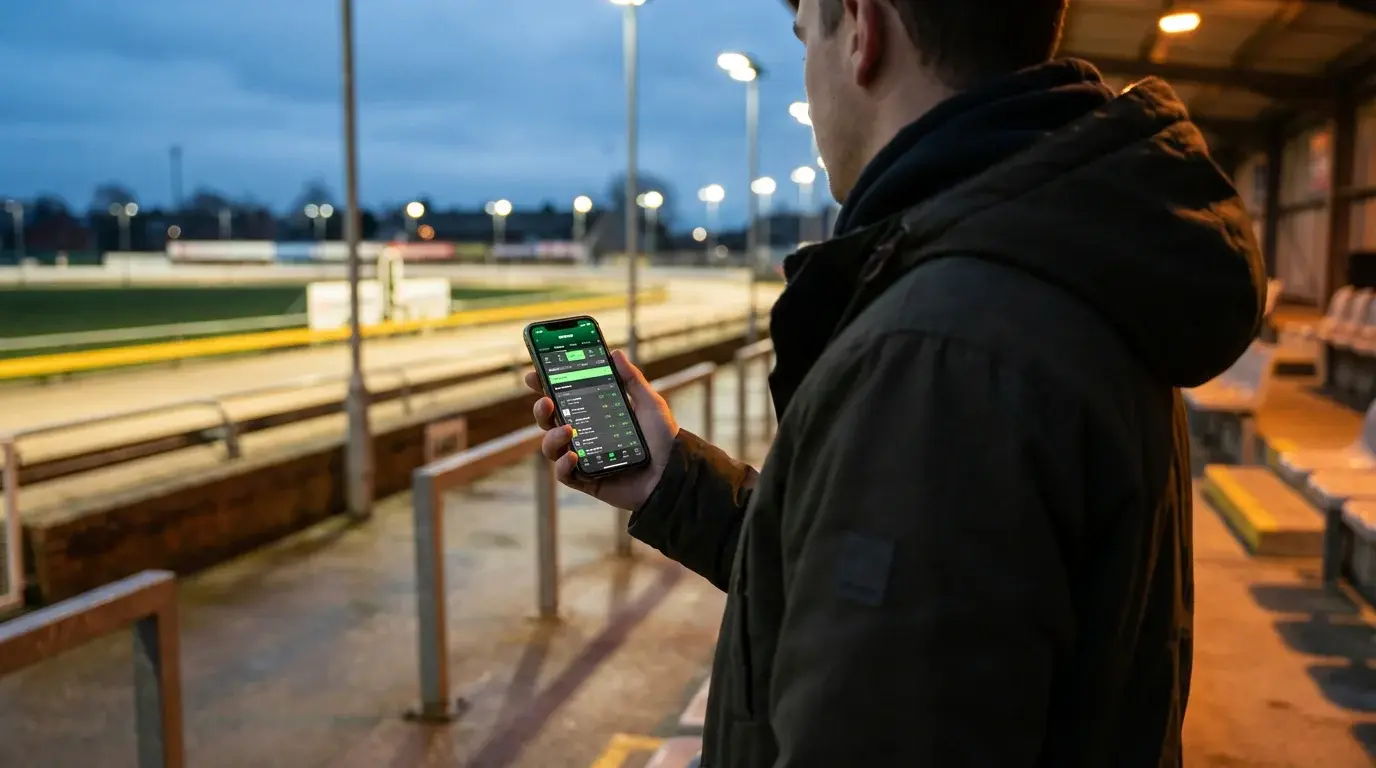
Beyond the headline features, there are practical criteria that separate the genuinely useful greyhound bookmakers from the ones that tick boxes on paper but disappoint in practice. Live streaming quality varies — some firms stream every BAGS meeting in sharp resolution, others offer patchy coverage with frequent buffering. Early prices are only useful if they are competitive, not artificially wide to discourage early betting. BOG is only valuable if the bookmaker actually applies it without hidden restrictions. The devil, as always, is in the details.
Payout limits matter too. Some bookmakers impose low maximum payouts on greyhound forecast and tricast bets, which effectively caps your winnings on the more exotic wagers. If you regularly bet forecasts, check the small print. Similarly, some firms will restrict or close accounts that consistently profit from greyhound betting, particularly on smaller meetings. This is a known issue across the industry and there is no easy solution beyond spreading your action across multiple accounts.
Bookmaker Selection Checklist
- Licensed by the UK Gambling Commission with a clean regulatory record
- Offers best odds guaranteed on greyhound racing as standard
- Provides live streaming for all GBGB tracks and major Irish meetings
- Publishes early prices at least thirty minutes before each race
- Covers forecast, tricast and each-way markets on all meetings
- Transparent maximum payout limits that are reasonable for your staking level
Best Odds Guaranteed: How It Works on Dogs
Best odds guaranteed removes the gambling from gambling — at least on price. You take a fixed price on a greyhound before the race. If the starting price is higher, the bookmaker pays at SP instead. If the SP is lower, you keep your original price. Either way, you get the better of the two.
For greyhound betting, BOG addresses a fundamental problem. Greyhound markets are volatile — a dog priced at 5/1 in the morning can drift to 7/1 or shorten to 3/1 by post time. Without BOG, taking early prices carries genuine risk. With BOG, you take the 5/1, and if the dog goes off at 7/1, you get paid at 7/1. The only complexity is that not every bookmaker offers BOG on greyhounds, and terms vary between those that do.
Some bookmakers apply BOG only to win bets, not each-way or forecast wagers. Others restrict it to certain meetings. A few impose time limits: you must take the price a certain number of minutes before the off for BOG to apply.
Timing restriction: Some bookmakers require your bet to be placed at least five to ten minutes before the off for BOG to apply on greyhounds. Bets placed in the final minutes may settle at the price taken, even if the SP is higher. Check your bookmaker's specific terms.
The strategic implication: maintaining at least one account with a bookmaker that offers unrestricted BOG on dogs is essential. It lets you take early prices with confidence. Combine BOG with an odds checker and you have a two-part system — the checker identifies the best price, BOG captures any further upside before the traps open.
Live Greyhound Odds and Market Movements
Greyhound markets move fast — prices can halve in the final two minutes before a race. Understanding why they move, and what those movements signal, separates informed punters from those who are just along for the ride.
A "steamer" is a dog whose price shortens rapidly before the off. At 8/1 ten minutes out, 5/1 five minutes later, 3/1 by post time. This usually means significant money has been placed, either by punters acting on form analysis or by connections who know the dog is in peak condition. A "drifter" is the opposite — a dog whose price lengthens as money fails to materialise. A drift might signal a poor parade, disappointing trial times, or simply that another dog is attracting heavy support and the market is rebalancing. Context matters.
Live odds feeds — available through most major bookmaker apps and comparison sites — let you watch these movements in real time. Some punters wait for a late market move before betting. Others use it to confirm their pre-race analysis. If your selection has drifted significantly, the market is disagreeing with you. That does not mean you are wrong, but it should prompt a re-examination.
The optimal betting window for most greyhound races is fifteen to twenty minutes before the off — late enough that the market has settled, early enough that you still capture BOG upside if the price shortens further.
Greyhound Betting Strategy Fundamentals
Strategy in greyhound betting is not about predicting winners — it is about finding prices that overestimate risk. A punter asks "which dog will win?" An investor asks "is this dog's price longer than its true chance justifies?" Both might back the same dog, but the investor's question leads to a systematic edge that compounds over hundreds of bets.
The concept underlying all profitable betting is expected value. Every bet has a probability of winning and a payout if it wins. Multiply the two and you get the expected return per pound staked. If that number is greater than one, the bet has positive expected value. The entire architecture of bookmaker margins is designed to ensure the average bet has negative expected value. Your job is to find the exceptions.
In greyhound racing, positive expected value arises from specific situations. A dog with strong form drawn in a favourable trap at a track where that trap consistently outperforms. A recent kennel switch not yet reflected in the market. A dog returning from a short break with a known tendency to improve after rest. These are analytical conclusions based on freely available data.
The challenge is discipline. Many races contain no value at all — every dog is priced roughly where it should be. The temptation is to bet anyway because the race is about to start. Resisting that temptation is the single most important strategic skill. The races where you do not bet are as important as the ones where you do.
Finding Value in Greyhound Odds
Value exists when the bookmaker's price implies a lower probability than the dog's actual chance of winning. A dog with a true 25 percent chance priced at 5/1 (implied probability 16.7 percent) is a value bet. At 3/1 (implied 25 percent) it is a fair price. At 2/1 (implied 33 percent) it is a poor bet.
Several data points help estimate true probability. Trap statistics provide a baseline adjustment. Recent form — read in context — tells you whether the dog is improving, declining or stable. Sectional times reveal pace potential. Grade changes indicate class shifts. Running comments flag luck factors that might reverse. Layered together, these create a more nuanced probability estimate than the market average.
The odds checker plays a critical role. Once you identify a dog you believe is overpriced, checking the price across bookmakers captures maximum value. A dog you assess at 4/1 fair price showing 6/1 at one firm and 5/1 at another represents different degrees of value. The checker finds the 6/1. The compound effect of consistently taking the best price on value selections is where long-term profitability is built.
Bankroll Management for Dog Racing
No strategy survives without a bankroll to execute it. The fastest way to go bust is not bad selections — it is bad staking. Chasing losses, doubling up after a losing run, or betting more than you can afford on a single race. These are emotional failures, and they destroy more bankrolls than bad form reading ever will.
Define a bankroll — a fixed amount allocated exclusively to greyhound betting — and stake one to three percent per bet. On a hundred-pound bankroll, that means one to three pounds. It feels small. It is meant to. The purpose is surviving losing runs, because even a profitable system will go through stretches of twenty or thirty losing bets.
Do
- Set a fixed bankroll separate from your living expenses
- Stake one to three percent of the bankroll per bet
- Track every bet in a spreadsheet with selection, odds, stake and result
- Review performance monthly and adjust strategy based on data, not emotion
Don't
- Chase losses with bigger stakes after a bad night
- Increase bet size because you "feel" a winner is due
- Bet money you cannot afford to lose
- Skip the record-keeping — without data, you cannot know if your approach works
UK Greyhound Tracks Overview
Eighteen GBGB-licensed stadiums operate across England and Wales as of early 2026, each with its own character, distances and trap tendencies. The sport runs almost every day of the year, split between afternoon BAGS meetings and evening cards. Understanding track differences is essential because a dog that excels at one venue may struggle at another due to configuration, surface or distance.
London and the South East host several busy tracks. Romford is a tight sprint venue popular for its rapid turnaround. Central Park in Sittingbourne has re-established itself on the BAGS circuit. Brighton and Hove produces competitive racing across multiple distances on the coast.
In the Midlands and North, Monmore Green in Wolverhampton draws strong crowds four nights a week. Dunstall Park, also in Wolverhampton, opened in September 2025 as a purpose-built facility inside the existing horse-racing course. Nottingham hosts high-quality open races and is considered one of the fairest tracks for all trap positions. Belle Vue and Newcastle round out the major northern venues.
Towcester in Northamptonshire holds special status as the home of the English Greyhound Derby — the sport's most prestigious event, carrying a 175,000-pound winner's prize. The 2025 running saw 10/1 outsider Droopys Plunge take the title from trap one, trained by Patrick Janssens, in a field that included the defending champion and the Irish Derby winner. Under updated 2026 GBGB Rules of Racing, all licensed stadiums must now maintain published homing policies for retired greyhounds and injury retirement protocols.
For betting purposes, specialise. Pick three or four tracks where you understand the trap biases, know the typical times, and can recognise the regular runners and trainers. Depth of knowledge beats breadth in greyhound racing.
Common Questions About Greyhound Odds
Three questions that land in our inbox every single day. Here are the answers, without the waffle.
How do greyhound betting odds work in the UK?
UK greyhound odds are most commonly displayed in fractional format — 5/1, 7/2, 11/4 and so on. The first number represents profit relative to the second number, which is your stake. At 5/1, a one-pound bet returns five pounds profit plus your stake back, totalling six pounds. Decimal odds show total return per pound: decimal 6.00 equals fractional 5/1. The starting price is the official odds when the traps open. Many bookmakers offer early fixed prices so you can lock in a price hours in advance, and best odds guaranteed means you receive whichever is higher — your fixed price or the SP.
Which greyhound trap wins most often?
Across the majority of UK greyhound tracks, trap one — the inside box closest to the rail — produces the highest win rate. This is because dogs in trap one have the shortest run to the first bend and can tuck onto the rail earliest, saving ground through every turn. However, the extent of this advantage varies significantly by track. Tight, compact tracks like Romford show a strong inside bias, while wider tracks like Nottingham produce a more balanced distribution across all six traps. It is also important to note that racing managers deliberately seed dogs according to running style: confirmed railers go in traps one and two, wide runners go in traps five and six. This means the trap bias is partly a product of which type of dog is drawn there, not purely a track geometry effect. Always check trap statistics for the specific track and distance before using trap position as a betting factor.
What is the difference between forecast and tricast bets?
A forecast bet requires you to predict the first two finishers in a greyhound race. A straight forecast demands the correct order — you must name the winner and the second-placed dog. A reverse forecast covers both possible orders and costs double the stake. A tricast bet extends this to three dogs: you must predict first, second and third in the correct order. A combination tricast covers all six possible arrangements of your three selections and costs six times the unit stake. Tricast payouts are significantly larger than forecast payouts because predicting the top three in order is substantially more difficult. Both bet types use the Computer Straight Forecast or Computer Tricast formula for payout calculation, which is based on the starting prices of all runners in the race rather than fixed odds.
The Thirty-Second Edge
Greyhound racing happens in half a minute. The work that wins happens before the traps open. Every concept in this guide — odds mechanics, price comparison, bet types, trap analysis, form reading, bookmaker selection, market timing, value identification, bankroll discipline — feeds into those moments between deciding to bet and clicking "place bet." The race is out of your hands. The preparation is not.
The greyhound betting market is not a level playing field. Bookmakers build margins into every race. Casual punters bet on favourites and ignore trap statistics. The public backs dogs they recognise and overlooks runners dropping in grade with strong sectionals. These inefficiencies exist in every card, at every track.
An odds checker does not tell you which dog to back. What it does is ensure that when you have done the work — read the form, checked the bias, assessed the pace — you capture the maximum return on that judgment. It turns good analysis into good bets, consistently, every race.
The margins in greyhound betting are thin. The difference between a losing year and a break-even year often comes down to single-digit percentage improvements in the prices you take. An odds checker delivers that improvement for free, in thirty seconds. In a sport that lasts thirty seconds, that might be the most valuable thirty seconds of all.
