 Available in US
Learn how greyhound odds work in the UK. Fractional vs decimal odds, starting price, best odds guaranteed explained with examples.
The Language of Greyhound Odds
Every price on a greyhound represents a bookmaker’s opinion translated into numbers. That 5/1 against a dog in trap four isn’t a random figure—it’s a calculated assessment of probability, adjusted to ensure the bookmaker makes money regardless of which dog crosses the line first. Understanding how these numbers work, what they actually mean, and how to convert them into actionable information separates punters who win consistently from those who simply gamble.
Greyhound odds function identically to horse racing odds in their basic mechanics. A price tells you how much profit you’ll make relative to your stake if your selection wins. But the context differs. Horse racing fields can contain twenty runners; greyhound traps hold six (GBGB Rules of Racing). This compressed field creates tighter markets, more competitive pricing, and—crucially for the informed bettor—more opportunities to find value when bookmakers get their assessments wrong.
The British betting market predominantly uses fractional odds, though decimal formats have gained ground thanks to European betting exchanges and younger punters raised on international sports betting. Both systems convey the same underlying information in different packaging. Neither is inherently superior, but fluency in both allows you to spot pricing discrepancies faster and calculate returns without friction.
What makes greyhound odds particularly worth understanding is the speed at which they move. A horse racing market might settle hours before the off; greyhound prices continue shifting until moments before the traps open. This volatility creates windows of opportunity. Take a price too early and you might miss a drift to better odds. Wait too long and a late surge of money can crush a value price into unbackable territory. Reading odds fluently lets you time your moves with precision rather than guesswork.
The pages ahead break down both major odds formats, explain how bookmakers build their margins into every market, and show you how to extract genuine probability estimates from the prices on your screen. By the end, numbers that once seemed arbitrary will start telling you stories—stories about what the market thinks, where it might be wrong, and where your money has the best chance of growing.
Fractional Odds: The Traditional UK Format
Fractions ruled British racing for centuries, and greyhounds are no exception. Walk into any licensed betting shop from Newcastle to Plymouth, and the boards display fractional odds as the default format. Television broadcasts, newspaper racing pages, and trackside bookmakers all speak in fractions. If you want to bet on British greyhounds without a calculator constantly in hand, you need to think fractionally.
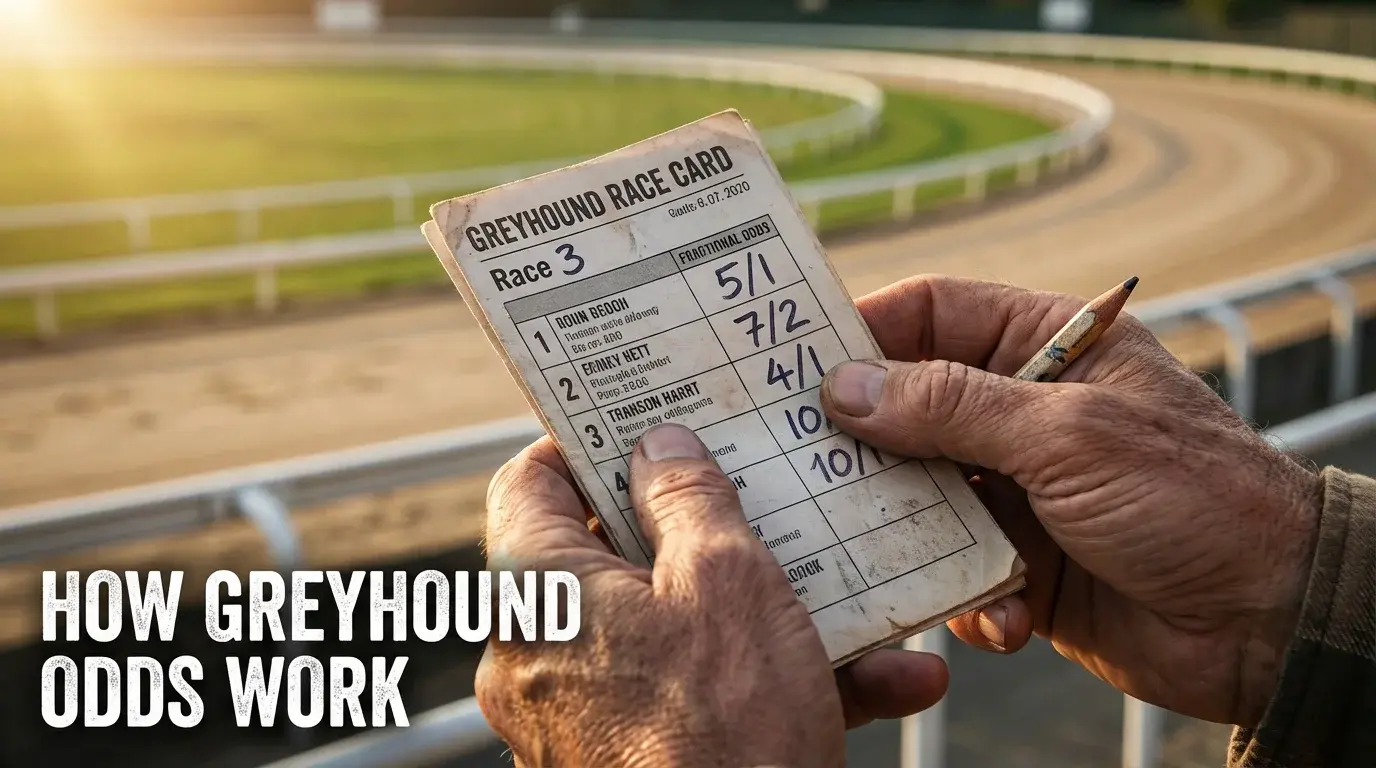
The fraction itself expresses the relationship between potential profit and stake. Odds of 4/1 mean four pounds profit for every one pound staked. Odds of 1/2 mean one pound profit for every two pounds risked. The number on the left always represents potential winnings; the number on the right represents the stake required to win that amount. Your stake is always returned on top of the profit, assuming your dog wins.
British greyhound betting traditionally clusters around certain familiar fractions. You’ll see 6/4, 7/4, 9/4, 5/2, 11/4, 3/1, 7/2, 4/1, 9/2, 5/1, 6/1, and so on. These aren’t arbitrary stopping points—they evolved from decades of bookmaker practice into a standardised vocabulary that allows quick mental arithmetic and instant comparison across different selections.
Evens, expressed as 1/1 or simply “evens,” sits at the mathematical centre of fractional odds. A winning evens bet doubles your money. Prices shorter than evens—like 4/5, 8/11, or 1/3—indicate favourites where you risk more than you stand to win. Prices longer than evens indicate outsiders where the potential return exceeds your stake. In a six-dog greyhound race, you’ll typically see one or two dogs at odds-on prices, two or three at single-figure odds, and one or two longer-priced outsiders.
How to Read Fractional Greyhound Odds
Reading fractional odds becomes instinctive with practice, but the principle never changes: the left number shows profit, the right number shows the stake generating that profit. Odds of 3/1 pay three times your stake in profit. Odds of 7/4 pay one and three-quarter times your stake. Odds of 1/4 pay a quarter of your stake—you’re risking four pounds to win one.
Some fractions appear more frequently than others because bookmakers standardise their pricing. The jump from 4/1 to 9/2 represents a single increment in standard bookmaker practice, even though mathematically other fractions exist between them. Learning these standard steps helps you recognise when a price has moved and by how much. A drift from 7/2 to 4/1 represents one step; a drift from 7/2 to 5/1 represents two steps and signals more significant market movement.
Odds-against prices (anything greater than evens) indicate the bookmaker believes the dog has less than a 50% chance of winning. Odds-on prices indicate a greater than 50% implied probability. In greyhound racing, where six runners compete over short distances with significant randomness, even strong favourites rarely price shorter than 4/6 or 8/11. True odds-on jolly favourites exist, but they’re less common than in horse racing handicaps or football matches featuring overwhelming favourites.
Calculating Your Returns
The return calculation follows a simple formula: (Stake × Odds) + Stake = Total Return. For fractional odds, convert the fraction to a decimal multiplier first. Odds of 5/2 become 2.5, so a £10 stake returns £10 × 2.5 + £10 = £35 total, comprising £25 profit and your original £10 stake. Odds of 4/7 become approximately 0.57, so £10 at 4/7 returns roughly £10 × 0.57 + £10 = £15.70.
Most punters develop shortcuts for common odds. At 5/1, your profit equals five times your stake. At 7/2, multiply your stake by 3.5. At 11/8, multiply by 1.375—though most people round this to “roughly one and a half times the stake” for quick estimation. Precision matters when you’re betting serious money, but mental arithmetic suffices for assessing whether a potential return justifies the risk before you commit.
Place bets and each-way bets introduce additional complexity. The place portion typically pays at one-quarter the odds for greyhounds (Towcester Racecourse — Greyhound Betting Rules), though some bookmakers offer one-fifth odds when providing enhanced place terms on selected races. At 8/1 with standard 1/4 place terms, the win part pays 8/1 but the place part pays just 2/1. Understanding this multiplier prevents nasty surprises when your selection finishes second and the return seems smaller than expected.
Decimal Odds: The Modern Alternative
Decimal odds tell you exactly what you get back—stake included—with no mental arithmetic. Where fractional odds separate profit from stake in their expression, decimal odds combine them. A price of 4.00 means your total return is four times your stake. A price of 1.50 means your return is one and a half times your stake. Simple multiplication replaces the fraction-handling that trips up many newcomers to betting.
The format dominates betting exchanges, online sportsbooks with international audiences, and European markets. Betfair displays decimal odds by default. Many UK bookmakers now offer decimal display as an account setting. Younger punters who learned betting through online platforms often find decimals more intuitive than the fractions their parents used.
Decimal odds also simplify comparison shopping. Is 7/2 better than 3.60? You need to convert fractional to decimal (7/2 = 4.50) to compare directly. Working in decimals from the start eliminates this step. When you’re scanning multiple bookmakers for the best price on a greyhound, decimal display lets you spot the top offer instantly without mental conversion.
The psychological difference matters too. Fractional odds emphasise profit relative to stake—how much you win. Decimal odds emphasise total return—how much ends up in your account. Neither perspective is more accurate, but knowing both prevents confusion when switching between platforms that default to different formats.
Converting Between Formats
Converting fractional to decimal requires one calculation: divide the fraction, then add one. Odds of 5/1 become (5÷1) + 1 = 6.00. Odds of 7/4 become (7÷4) + 1 = 2.75. Odds of 4/9 become (4÷9) + 1 = 1.44 approximately. The added “one” accounts for the stake return that decimal odds include and fractional odds exclude.
Converting decimal to fractional reverses the process: subtract one, then express as a fraction. Decimal 3.50 becomes 3.50 – 1 = 2.50, which equals 5/2 when expressed as a fraction. Decimal 1.80 becomes 0.80, which equals 4/5. Some decimal prices don’t convert to neat fractions—2.87 becomes 1.87/1 or roughly 15/8—but standard bookmaker pricing usually sticks to equivalents of common fractional odds.
Memorising common conversions saves time. Evens (1/1) equals 2.00. 6/4 equals 2.50. 2/1 equals 3.00. 5/2 equals 3.50. 3/1 equals 4.00. 7/2 equals 4.50. 4/1 equals 5.00. 5/1 equals 6.00. 6/1 equals 7.00. Running through this list a few times builds the intuition needed to flip between formats without conscious calculation.
Implied Probability and Bookmaker Margins
A 4/1 shot isn’t really a 20% chance—the margin ensures the house always takes its cut. Every set of odds implies a probability that the selection will win. Understanding this implied probability unlocks the ability to assess whether a price represents value or whether the bookmaker has overpriced the risk. Without this knowledge, you’re betting blind.
The implied probability of any odds can be calculated by dividing one by the decimal equivalent. Odds of 4.00 (3/1) imply a probability of 1÷4.00 = 0.25 or 25%. Odds of 2.00 (evens) imply 50%. Odds of 1.50 (1/2) imply 66.7%. The higher the odds, the lower the implied probability; the lower the odds, the higher the implied chance the bookmaker believes the selection has.
Here’s where bookmakers make their money: they set odds so that the implied probabilities of all runners sum to more than 100%. In a fair market, six greyhounds with equal chances would each be priced at 5/1 (6.00 decimal), implying 16.67% each—totalling exactly 100%. Bookmakers don’t offer fair markets. They price those same dogs at perhaps 9/2 each, implying 18.2% each—totalling 109.2%. That extra 9.2% represents the overround, the built-in margin guaranteeing profit regardless of which dog wins.
Calculating Implied Probability
The formula remains consistent: Implied Probability = 1 ÷ Decimal Odds. For fractional odds, first convert to decimal. Odds of 7/2 convert to 4.50, so implied probability equals 1÷4.50 = 0.222 or 22.2%. Odds of 11/8 convert to 2.375, giving 1÷2.375 = 0.421 or 42.1%. This calculation works for any odds format once you’ve converted to decimal.
Probability assessment becomes central to value betting. If your own analysis suggests a dog has a 30% chance of winning but the bookmaker prices it at 5/1 (implying only 16.7%), you’ve found potential value. The inverse applies equally—a dog you rate at 15% priced at 4/1 (20% implied) offers no value despite looking like a reasonable price. This isn’t mystical insight; it’s basic mathematics applied to betting.
Developing the ability to estimate probabilities independently of odds takes practice. Start by making your own assessments before looking at prices. Over time, you’ll develop intuition for where odds diverge from reality. That divergence is where profit lives.
Understanding the Overround
The overround—also called the margin, vig, or juice—measures how much bookmaker profit is baked into a market. Calculate it by summing the implied probabilities of all runners. A six-dog race where probabilities sum to 118% has an 18% overround. That 18% represents the mathematical edge bookmakers hold before you even place a bet.
Greyhound racing typically carries overrounds between 112% and 125%, depending on the bookmaker and the market. Major races at premium tracks sometimes see tighter margins near 112%, while obscure afternoon meetings might push toward 125%. Lower overround means better value for punters; higher overround means more margin extracted per bet.
Comparing overrounds across bookmakers reveals which offers consistently better value. A bookie running 115% margins returns more to customers over time than one running 122% margins. This difference compounds across hundreds of bets. Smart punters track these percentages and weight their business toward lower-margin operators, particularly when best odds guaranteed eliminates the downside risk of taking early prices.
Starting Price: When Odds Finalise
The starting price is set moments before the traps open—the market’s final word. Every greyhound race produces an official starting price for each runner, determined by the prices available at the moment the race begins. This SP becomes the definitive odds for anyone who didn’t take an earlier fixed price, and it serves as the reference point against which all other prices are measured.
On-course bookmakers historically set the starting price through their offered odds at race time. Today, industry starting prices for greyhounds derive from a calculation based on the prices offered by major on-course and off-course bookmakers. The methodology ensures SP reflects genuine market sentiment rather than manipulation by any single operator.
Taking SP means accepting whatever the final odds settle at. You don’t know your price when you place the bet. If the dog drifts from 4/1 to 6/1, you get 6/1. If it steams from 4/1 to 5/2, you get 5/2. This uncertainty cuts both ways, which is why many experienced punters prefer taking early prices when they spot value—locking in a favourable number before market movements can erase it.
SP betting suits situations where you can’t monitor markets before the race, or where you believe prices will drift rather than contract. Some punters use SP strategically for outsiders they expect will be ignored by the market, hoping the final price exceeds early quotes. Others accept SP simply for convenience, trusting that best odds guaranteed (where available) provides insurance against unfavourable movements.
The practical implication for greyhound betting is timing awareness. Races happen quickly, often every fifteen minutes at busy meetings. If you’re juggling multiple selections across different races, taking SP reduces the mental load but sacrifices control over your price. Knowing when to accept this trade-off separates systematic bettors from reactive gamblers.
Taking an Early Price vs Waiting
Early prices carry risk and reward; the trick is knowing which side of the coin you’re on. Bookmakers release early prices hours or even days before races, particularly for evening cards and weekend meetings. These opening prices represent initial assessments subject to revision as market sentiment develops. Taking them means betting before the full picture emerges.
The case for early prices centres on capturing value before it disappears. If you’ve identified a dog you believe is overpriced, taking the morning price locks in that edge regardless of subsequent market movements. Informed money flowing onto your selection later will shorten the odds, but you’ve already secured your position. Early movers often get the best prices.
The argument against early prices acknowledges that information develops throughout the day. Late scratching, kennel whispers about a dog’s well-being, weather changes affecting track conditions—all can alter the genuine probabilities after early prices publish. Taking a price before this information filters through means betting on incomplete data.
Form and trap draw provide reasonably stable inputs available from race declaration. These factors support early price-taking since they won’t change. Weather and track conditions require monitoring closer to race time. Kennel intelligence—always difficult to access—tends to influence markets later when connections place their own bets. Understanding which factors might shift helps assess whether early prices have fully accounted for relevant information.
The middle path involves watching early markets without committing, identifying selections where you have conviction, and striking when your target price appears—whether that’s in morning markets, afternoon trading, or final minutes. This approach demands more attention but optimises the balance between securing value and incorporating late information.
Best Odds Guaranteed on Greyhounds
BOG turns early-price anxiety into a free option on better odds. Best odds guaranteed promises that if you take an early price and the starting price exceeds it, you’ll be paid at the higher SP rather than your original odds. This promotion eliminates the downside of early betting while preserving its upside. In markets where it applies, BOG makes taking early prices an almost unambiguously good decision.
The mechanics work automatically with most bookmakers. You back a dog at 4/1 in the morning. By race time, the price has drifted to 6/1 SP. Under BOG, your winning bet pays at 6/1 rather than your original 4/1. You captured any value present in the morning price while gaining exposure to favourable drift. Had the price shortened to 5/2 instead, you’d still collect at your original 4/1.
Not all bookmakers extend BOG to greyhound racing. Horse racing almost universally qualifies, but greyhound coverage varies. Before taking early prices, verify that your bookmaker includes greyhounds in their BOG promotion. Those that don’t leave you exposed to adverse market movements without the protection BOG provides.
BOG particularly benefits punters who bet on outsiders. These selections often drift further as casual money flows toward favourites. A 10/1 early price drifting to 14/1 SP delivers a 40% better return under BOG—the kind of edge that compounds significantly over hundreds of bets. Conversely, favourites usually see their odds contract, so BOG provides less benefit for odds-on fancies.
BOG Terms and Restrictions
Bookmaker terms typically restrict BOG to bets placed after a certain time, often morning prices only or prices taken within specified hours of the race. Some exclude bets placed in the final minutes before the off. Read the specific terms of your bookmaker’s BOG offer rather than assuming universal application.
Maximum payout caps sometimes limit BOG benefits. A bookmaker might offer BOG up to winnings of £10,000 or similar thresholds. High-rolling punters could find their excess winnings above this cap paid at original odds rather than SP. For recreational bettors, these caps rarely bite, but they’re worth noting.
BOG typically excludes betting exchanges and tote pools, applying only to fixed-odds bookmaker bets. Enhanced odds promotions and special offers may also fall outside BOG coverage. The safest assumption is that only standard win and each-way bets on regular markets qualify, though specific terms vary between operators.
How Greyhound Odds Move Before a Race
In the final minutes, greyhound markets can shift more dramatically than any football match. Prices that looked stable all morning can halve or double in the closing moments as late money floods in. Understanding what drives these movements—and what they signal—helps you interpret market information rather than simply reacting to it.
Steamers are selections whose odds shorten rapidly as money arrives. A dog opening at 6/1 that closes at 3/1 has steamed. This movement typically indicates informed money: connections backing their own dog, professional punters acting on specific intelligence, or simply heavy public interest concentrating on one runner. Steamers don’t always win, but persistent shortening often reflects genuine expectations.
Drifters move the opposite direction. A 3/1 favourite drifting to 5/1 suggests money flowing away from that selection—possibly toward another dog that’s steaming, or simply reflecting reduced confidence from those who know the kennels. Dramatic drifts sometimes indicate problems: a dog that looked slightly off in the parade, whispers about recent poor home trials, or simply bookmakers laying off their exposure.
Market movements in greyhound racing happen faster than in horse racing because the pools are smaller and races more frequent. A single large bet can visibly move prices, whereas horse racing markets absorb bigger stakes with less disturbance. This volatility creates opportunities for those watching closely but punishes those who place bets and walk away.
The most useful skill is distinguishing meaningful moves from noise. A small drift on an outsider might simply reflect bookmakers balancing their books. A significant contraction on the favourite might indicate nothing more than casual punters following the obvious choice. But a sustained steamer from 8/1 to 4/1 accompanied by kennel money flowing in specific patterns—that’s information worth weighing heavily.
What Influences Greyhound Odds
Form, draw, weather, and whispers from the kennel—everything feeds into the price. Bookmakers don’t pluck odds from thin air. They analyse the same factors available to punters, then add their margin and adjust based on market activity. Understanding what drives their initial assessments helps you spot where their analysis might diverge from reality.
Recent form weighs heavily in initial pricing. A dog that has won its last three races will price shorter than one coming off a string of mid-field finishes. Consistency matters particularly at lower grades where the quality gap between runners is smaller. But form can mislead when it reflects favourable draws rather than genuine ability, or when a dog drops or rises in grade.
Trap position influences odds significantly in greyhound racing, more so than draw in horse racing. A proven railer drawn in trap one prices shorter than the same dog drawn in trap six. Wide runners fare better from outside traps. Bookmakers build these preferences into their tissue, but they may under- or overweight draw compared to other factors.
Track conditions interact with individual running styles. Some dogs handle rain-affected tracks better than others. Evening races on cold nights differ from afternoon cards in summer. Bookmakers attempt to factor conditions into their assessments, but their models may lag behind changing circumstances—particularly when weather shifts between pricing and race time.
Kennel intelligence remains the least accessible factor. Trainers know things that never reach public form—how a dog has been trialling at home, whether it’s carrying a minor niggle, if it’s been freshened up for a specific target race. This information sometimes leaks into markets through connections’ betting patterns, but punters without inside access must infer rather than know. When markets move sharply without obvious public explanation, kennel money often provides the hidden cause.
Weight of money ultimately determines final prices. All the factors above inform opening odds, but subsequent betting activity reshapes the market. Heavy backing shortens prices regardless of underlying merit. Lack of interest lets prices drift even on well-fancied selections. The interplay between fundamental factors and market dynamics creates the constantly shifting landscape of greyhound odds.
Numbers That Speak
Learning odds isn’t about memorising formulas—it’s about developing an instinct for value. The mathematics matter, certainly. Converting between fractional and decimal, calculating implied probabilities, understanding overrounds—these technical skills form the foundation. But the real payoff comes from integrating this knowledge into rapid, almost unconscious assessments when you’re scanning markets for your next bet.
Every price contains information. The 4/1 on trap three tells you what the market collectively believes about that dog’s chances. Whether that belief aligns with reality is the question you need to answer. Sometimes the market is right, and the price fairly reflects the probability. Sometimes the market is wrong, and the price represents opportunity.
Distinguishing fair prices from mispriced opportunities requires both statistical understanding and contextual knowledge. You need to know what odds mean mathematically before you can assess whether they’re justified in practice. The preceding sections have provided the mathematical framework. Applying it to real races requires watching markets, tracking results, and developing pattern recognition that only comes with experience.
The greyhound punter who understands odds operates at a different level from one who simply picks dogs and hopes for the best. Odds comprehension transforms betting from pure speculation into probability assessment. It doesn’t guarantee wins—nothing does—but it ensures you’re playing the same game as the bookmakers rather than a different, losing game of your own invention.
Find the latest greyhound odds at greyhoundoddschecker.
Also read our live greyhound odds guide.
