 Available in US
Romford Greyhound Racing: Track Guide, Tips and Trap Bias Romford: London's Premier Sprint Track Romford is the track that most serious greyhound punters in the
Romford: London’s Premier Sprint Track
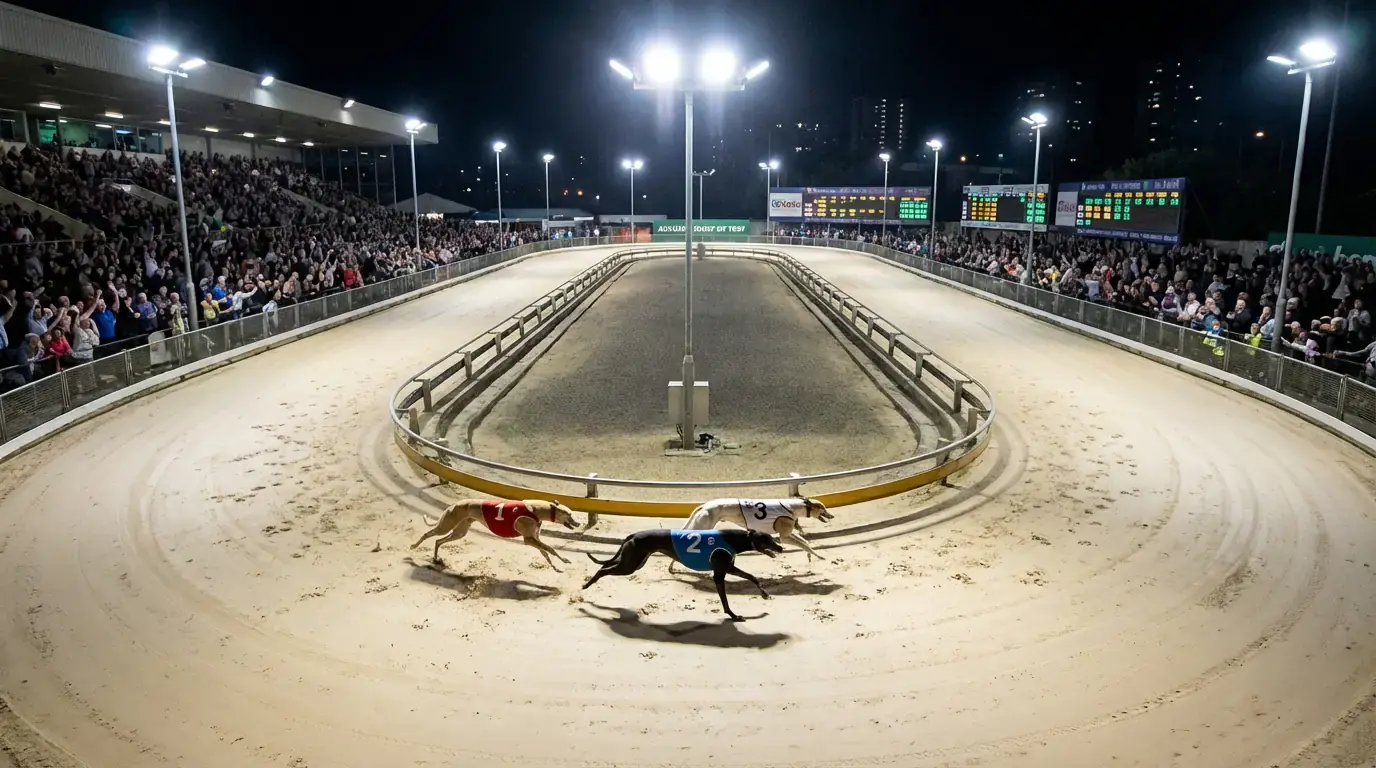
Romford is the track that most serious greyhound punters in the South East know best. Situated in the London Borough of Havering, the stadium has been a fixture of British dog racing for decades and remains one of the busiest and best-supported venues on the GBGB circuit. Its reputation is built on sprint racing, tight bends and an atmosphere on evening cards that few other tracks can match.
For bettors, Romford offers something specific and valuable: consistency. The track surface, the race programme and the standard of competition are reliable enough that form analysis works here. Dogs that perform well at Romford tend to repeat, and the trap bias patterns are stable enough across seasons to inform genuine strategy. This is not a track where you need to guess. It is a track where homework pays off.
This guide covers everything a punter needs to know about Romford: the track dimensions, the distances on offer, the trap bias data, and practical advice for betting on the dogs at London’s premier sprint venue.
Track Profile and Layout
Romford operates on a compact oval circuit with four bends. The circumference is relatively tight compared to tracks like Towcester or Perry Barr, and this compactness defines the character of the racing. Bends come up quickly after the start, and the straights are short enough that dogs rarely have time to build sustained momentum on the flat. The result is racing that rewards early pace and clean trapping above almost everything else.
The track surface is sand, maintained to a consistent standard that produces reliable going for the majority of meetings. Heavy rain can affect the surface and alter running times, but Romford’s drainage is generally good and the track recovers quickly. The racing manager monitors conditions closely, and meetings are rarely abandoned due to weather at this venue.
The first bend at Romford is the decisive point of most races. Because the run from the traps to the first turn is short, dogs that break cleanly and establish position on the rail have a significant structural advantage. A dog that finds trouble at the first bend, whether through crowding, interference or a slow break, has very little time to recover before the next turn. This is why trap draw and early speed are weighted so heavily by informed Romford punters.
The home straight is where finishes are decided, but the positions are largely set by the time the field enters it. Late closers can pick up places on the run to the line, particularly if the leaders have exerted themselves through the bends, but outright reversals of fortune in the straight are uncommon. Romford racing is front-loaded: what happens in the first five seconds shapes the final result more often than not.
Distances and Race Types
Romford’s race programme is built around sprint and middle distances. The headline distance is the 400-metre sprint, which is a sharp, single-circuit dash that tests early speed and trapping ability. At 400 metres, there is almost no time for a dog that loses ground at the start to recover. The sprint races at Romford attract specialist speedsters that break fast and hold their position through the bends.
The standard middle distance is around 575 metres, covering one and a half circuits of the track. This distance introduces a second element beyond pure early pace: the ability to sustain speed through additional bends and maintain position on the second lap. Middle-distance racing at Romford still favours dogs with early speed, but it also rewards dogs that settle into a rhythm and stay balanced through the turns.
Stayers’ races at longer distances are available but less frequent. These events attract a smaller pool of specialist dogs and can produce less predictable results, partly because the form base at staying distances is thinner. For the regular punter, the sprint and middle-distance cards are where the form is deepest and the analysis is most productive.
Graded races form the bulk of the programme. Dogs are graded by the racing manager based on recent performance, and each grade features dogs of roughly similar ability. Open races, where the best dogs compete regardless of grade, are staged on feature nights and attract stronger fields and deeper betting markets. The distinction between graded and open racing matters for form analysis: a dog that dominates in A5 grade faces a different challenge when stepping up to open company.
Romford Trap Bias Analysis
Trap bias at Romford is one of the most pronounced and well-documented of any UK track. The inside traps, particularly Trap 1 and Trap 2, carry a measurable statistical advantage over the outside traps at sprint distances. This bias is a direct consequence of the track’s tight configuration and the short run to the first bend.
At 400 metres, Trap 1 has historically produced a win rate above what random probability would predict. The rail provides a natural line through the first bend, and a dog breaking cleanly from the inside can establish an unassailable position before the field has settled. Trap 2 benefits similarly, though to a slightly lesser degree, because the dog has a short angle to the rail if it shows early pace.
Traps 5 and 6 face the opposite challenge. Wide runners need to cover more ground through the bends and risk being shuffled back if the inside dogs break quickly. At sprint distances, where there is no time to make up lost ground, this positional disadvantage translates directly into lower win rates. The data is not subtle. Over a large sample of Romford sprints, the inside-to-outside win rate gradient is visible and consistent.
At middle distances, the bias softens. The additional circuit gives wide runners more opportunity to work into the race, and dogs with stamina rather than pure early speed can overcome a wider draw. Trap 1 still performs above average at middle distances, but the gap between inside and outside is narrower than at sprint trips.
Weather complicates the picture. A heavy track can amplify inside bias because the rail provides a cleaner racing line on a surface that saps energy. Conversely, a fast, dry track may reduce the advantage slightly by allowing wider runners to maintain their speed through the bends. Checking recent results for trap performance in current conditions is a habit that pays dividends at Romford more than at most other tracks.
One important caveat: trap bias is a tendency, not a certainty. A superior dog drawn in Trap 6 can still overcome the bias if it has the speed and class to dominate the race. Bias should inform your analysis, not dictate it. The punter who blindly backs Trap 1 in every sprint is exploiting a real edge but ignoring the individual quality of the runners, which matters more in any single race than the aggregate statistics.
Betting at Romford
Romford’s evening meetings generate some of the deepest greyhound betting markets in the UK. Multiple bookmakers price up the card competitively, and odds comparison tools typically show a full range of prices from six or more operators. This market depth is an advantage for the punter because it means genuine price competition and the ability to shop for the best odds on each race.
Best odds guaranteed is widely available on Romford races from the major bookmakers. Given the volatility of greyhound markets in the minutes before the off, BOG is particularly valuable here. A Romford sprint dog that attracts late support from kennel connections can see its price halved in the final two minutes, and BOG ensures that punters who took the early price are not penalised for their foresight.
Forecast betting at Romford is productive because the trap bias narrows the likely first and second finishers. In a sprint where Traps 1 and 2 carry structural advantages and one of them houses a strong railer, you can often construct a forecast around a plausible first-and-second scenario that the market does not fully price in. The combination of predictable racing patterns and decent-sized forecast dividends makes Romford one of the better tracks for this bet type.
For each way bettors, Romford sprints present a specific challenge: the races are often dominated by one or two dogs from the inside traps, and the place market is correspondingly tight. Each way value at Romford tends to sit in the middle-distance races where the finishing order is less predictable and dogs from wider draws have a realistic chance of placing.
Meeting Schedule
Romford hosts regular meetings throughout the week, with the schedule typically including both daytime BAGS cards and evening fixtures. The BAGS meetings provide steady action for punters who follow the track during the day, while the evening meetings attract stronger fields, bigger crowds and deeper betting markets.
Evening meetings at Romford are among the most popular in the UK greyhound calendar. The atmosphere at the stadium is lively, the racing is competitive, and the card usually features a mix of graded and open races that caters to different levels of analysis. Feature nights with higher-grade races and special events draw additional interest from bookmakers and punters alike, and the odds on these cards are typically the most competitive of the week.
The BAGS schedule is subject to change, so checking the upcoming fixtures for the week ahead is a sensible habit. Romford is a sufficiently active track that there is rarely a week without multiple meetings, giving the punter who specialises here a consistent stream of races to analyse.
Fast and Furious
Romford rewards the punter who embraces its identity. It is a sprint track with tight bends, pronounced trap bias and racing that is decided in the opening seconds. The punter who understands these characteristics and builds their analysis around early speed, trap draw and first-bend positioning will find that Romford delivers returns with a regularity that looser, more unpredictable tracks cannot match. The races are short. The preparation does not have to be.
Find more track guides at greyhoundoddschecker.
Also read our Romford greyhound racing article.
Find more track guides at greyhoundoddschecker.
Also explore our Romford greyhound racing guide.
