 Available in US
Greyhound Trap Draw: How Boxes Are Allocated and What It Means Why the Trap Draw Matters In greyhound racing, the trap draw is not random. Dogs are allocated st
Why the Trap Draw Matters
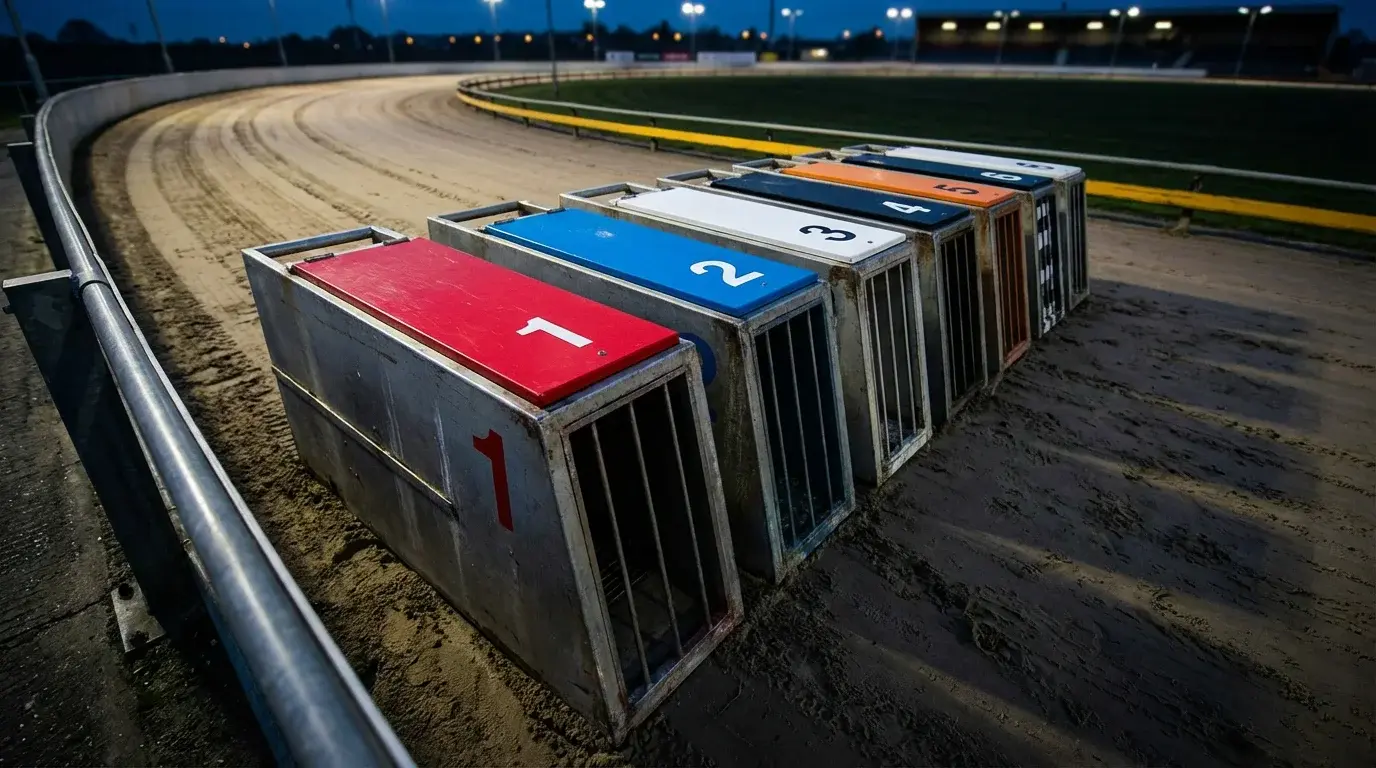
In greyhound racing, the trap draw is not random. Dogs are allocated starting positions based on their running style, and this allocation has a direct influence on how the race unfolds. A railer drawn in Trap 1 has a fundamentally different proposition from the same dog drawn in Trap 6, and understanding why that difference exists, how allocations are made, and what it means for betting is essential knowledge for any serious punter.
The draw shapes every race before a single dog has left the traps. It determines which runners have a clear path to the first bend, which face potential crowding, and which must cover extra ground to reach their preferred racing line. At tight tracks where the first bend arrives quickly, the draw can be the single most important factor in the result. At larger circuits the effect is diluted, but it never disappears entirely.
This guide explains the seeding system that drives trap allocation, breaks down the difference between railers, middle runners and wide dogs, and shows how to incorporate draw information into your betting analysis.
Seeding Explained
Seeding is the process by which the racing manager allocates dogs to traps based on their preferred running style. The principle is straightforward: dogs that favour the inside rail are seeded to the lower-numbered traps, dogs that run wide are seeded to the higher-numbered traps, and dogs with no strong preference fill the middle. The system exists to produce fair, competitive racing by giving each dog a starting position that suits its natural running line.
The racing manager makes seeding decisions based on a combination of previous race footage, trial observations and the dog’s recorded running style. A dog consistently described as a railer in its form comments will be seeded towards Traps 1 or 2. A dog that runs wide through the bends will be seeded towards Traps 5 or 6. Middle-track runners occupy the central traps.
Seeding is not mechanical or algorithmic. The racing manager exercises judgement, and two different managers at two different tracks might seed the same dog differently based on their observations and the track’s specific characteristics. A dog described as a middle runner at one venue might be treated as a railer at another if the track’s bend profile and width suit a slightly different racing line. This subjectivity is part of what makes draw analysis nuanced rather than formulaic.
The quality of seeding varies by track and by racing manager. Some managers are meticulous, producing draws that accurately reflect each dog’s style. Others are less precise, and their draws occasionally place a known railer in an outside trap or a wide runner on the rail. These mismatches are worth spotting because they create situations where a dog’s natural running style conflicts with its starting position, and the result is often a compromised run.
Railers, Middle Runners and Wide Dogs
A railer is a dog that naturally seeks the inside rail through the bends. These dogs hug the shortest path around the track, covering the minimum distance and conserving energy through each turn. Railers are the most common running style in greyhound racing because the rail provides a natural guide that suits the majority of dogs. When drawn in Trap 1 or 2, a railer has immediate access to the rail and can establish position before the first bend without crossing other runners.
A wide runner takes a line around the outside of the field through the bends. These dogs cover more ground than railers but avoid the congestion and interference that often occurs on the inside. Wide runners are most effective when they have the pace to lead the field into the bend from the outside or the stamina to sustain their wider racing line without fading. Drawn in Trap 5 or 6, a wide runner has clear space to establish its running line without being squeezed towards the rail.
Middle-track runners occupy the space between these two extremes. They neither hug the rail nor swing wide, running a middle line through the bends that keeps them clear of both rail-side crowding and the extra distance of a wide run. Middle runners are versatile but can be compromised if drawn in Trap 1 or Trap 6, where their natural line requires crossing into or away from the rail from an unfamiliar starting position.
A dog’s running style is not always fixed. Some dogs adapt their line depending on the pace of the race, the draw, and the behaviour of the runners around them. A natural railer that encounters traffic on the inside may switch to a middle or wide line. A wide runner in a slow-paced race may come inside to save ground. These adjustments happen in real time during the race, but the dog’s default style, the one it reverts to when unimpeded, is what the seeding system is based on and what you should analyse when assessing the draw.
The Allocation Process
Trap allocation happens when the racing manager compiles the race card, typically one to two days before the meeting. The manager selects six dogs for each race, considering their grade, recent form, preferred distance and running style. The draw is then assigned to give each dog a trap that matches its seeding profile as closely as possible.
In practice, perfect seeding is not always achievable. If a race contains three railers and only two inside traps, one railer must go in a middle or outside box. Similarly, if the race features four wide runners, some will be drawn inside their ideal position. These compromises are inevitable in a six-dog field, and they create the mismatches that astute punters look for when studying the card.
Some tracks publish seeding information alongside the race card, indicating each dog’s preferred running style. Others leave the punter to infer it from form comments and previous race data. Where seeding data is published, it provides a direct shortcut to understanding the draw. Where it is not, reading the form comments for phrases like “railed,” “middle,” “wide,” “challenged wide” or “rails run” gives you the same information with a little more effort.
The draw for major competitions like the Derby or St Leger is conducted separately for each round, and the randomisation element increases because the dogs have not necessarily raced at the host venue enough for detailed seeding data. In these events, the draw carries even more weight in the analysis because a sub-optimal trap allocation has a proportionally larger impact on a contender’s chance.
Draw Advantages and Disadvantages
The advantage of a good draw is simple: the dog starts in a position that gives it the clearest path to its preferred racing line with the least interference. A railer in Trap 1 at a tight sprint track has the rail from the moment the traps open. No crossing, no crowding, no wasted ground. The dog can run its natural race without compromise.
The disadvantage of a bad draw is the mirror image. A railer in Trap 6 must cross the entire field to reach the rail, and in the few strides between the traps and the first bend, that crossing is likely to involve contact, checking or a loss of momentum. Even if the dog eventually reaches the rail, the ground it has lost in getting there may be unrecoverable in a race that lasts thirty seconds.
The magnitude of the draw advantage varies by track and distance. At tight sprint tracks like Romford, where the first bend arrives almost immediately, the draw is a significant factor. At larger tracks like Towcester, where the run to the first bend is longer, dogs have more time to find their position and the draw advantage is reduced. At marathon distances where the field negotiates six or more bends, the cumulative effect of running wide adds up even on spacious circuits.
The market prices the draw to some extent. A known railer drawn in Trap 1 at a track with strong inside bias will typically be shorter in the odds than the same dog drawn in Trap 5. But the market’s adjustment is not always accurate. Sometimes the draw advantage is overpriced, creating value on the dogs drawn against it. Other times the market underweights the draw, particularly on dogs moving to a trap they have rarely occupied. The punter who understands both the draw dynamics and the market’s response to them is positioned to find value on either side.
Using Draw Information in Betting
Start every race card analysis with the draw. Before you look at form figures, times or grading, note which dog is in which trap and whether the allocation matches its running style. A glaring mismatch, such as a confirmed railer in Trap 6, is an immediate red flag that should lower your assessment of that dog’s chance regardless of how strong its recent form appears.
Cross-reference the draw with trap bias data for the specific track and distance. If Trap 1 at your target venue has a historical win rate of 22 percent against an expected 16.7 percent, a well-seeded railer in Trap 1 has a compounding advantage: the right dog in the right trap at a track that rewards inside runners. The convergence of seeding, trap bias and individual form is where the strongest betting positions emerge.
Track how dogs perform from different traps over their career. Some dogs are versatile and perform well from any box. Others are trap-dependent, racing significantly better from inside draws than outside or vice versa. Form databases that record the trap for each run allow you to filter a dog’s record by starting position, revealing these patterns. A dog showing form figures of 1-2-1-1 from Traps 1 and 2 but 4-5-6-3 from Traps 5 and 6 is not an inconsistent performer: it is a dog whose form is entirely explained by the draw.
The First Decision
The trap draw is the first piece of information you should process for every greyhound race you consider betting on. It shapes the probable running of the race, it amplifies or diminishes each dog’s natural ability, and it interacts with track-specific bias to create advantages that the form figures alone cannot reveal. A race that looks straightforward on form can become a completely different puzzle when you overlay the draw. The punters who read it accurately are the ones who find value the market misses.
Get more trap analysis at greyhoundoddschecker.
Also explore our traps guide.
