 Available in US
Greyhound Forecast Betting: How Straight and Reverse Forecasts Work Mastering Forecast Bets on Greyhounds Forecast betting multiplies risk and reward in equal m
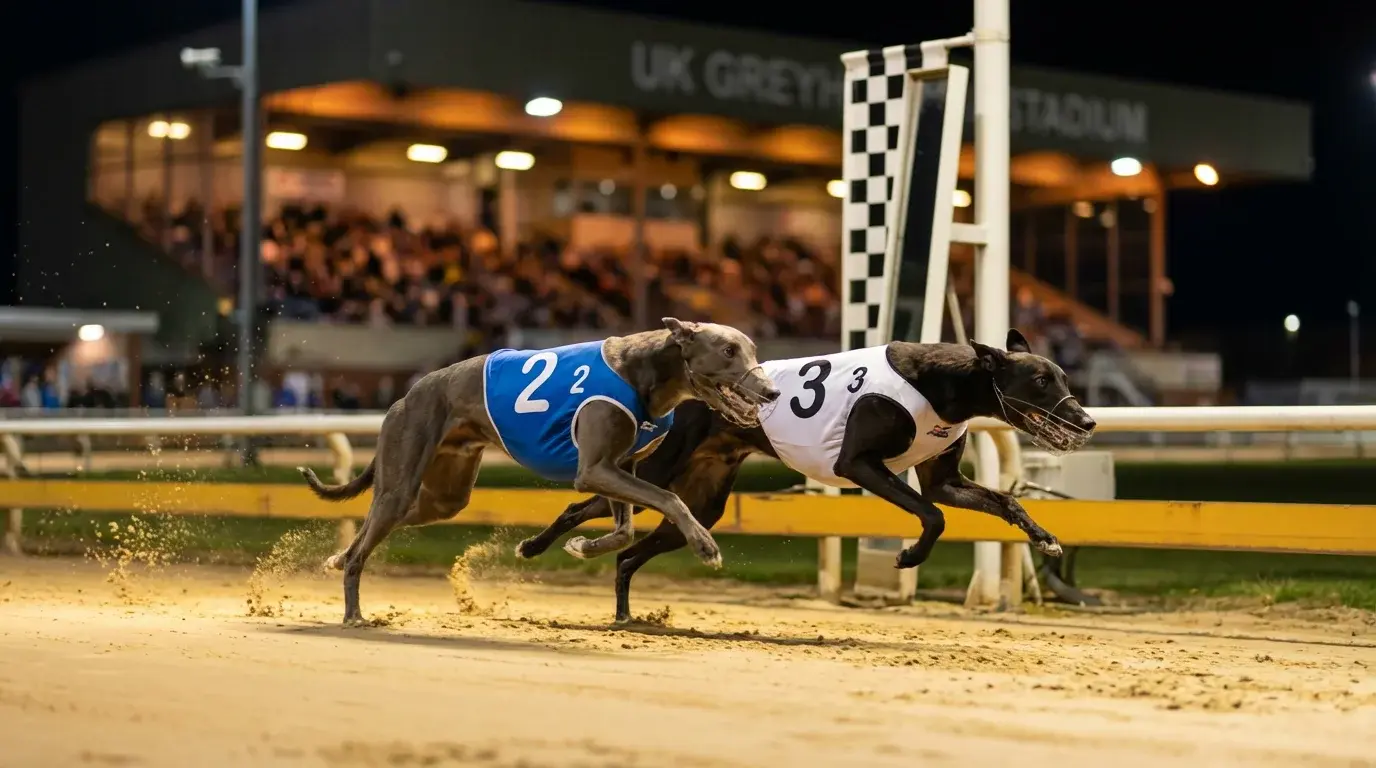
Mastering Forecast Bets on Greyhounds
Forecast betting multiplies risk and reward in equal measure. Where a win single asks you to find one dog, a forecast demands you identify two and put them in the right order. Get it wrong and you lose. Get it right and the returns dwarf anything a standard win bet can offer. In greyhound racing, where six-runner fields keep the number of possible outcomes manageable, forecasts sit in a sweet spot between difficulty and opportunity that makes them one of the most popular bet types at UK tracks.
The appeal is obvious. A race where the likely winner is priced at 2/1 does not offer much excitement on a win single. But if you can identify which dog finishes second, the forecast dividend can pay ten, fifteen, even twenty times your stake depending on the prices involved. Suddenly a race that looked unbet-worthy on a win basis becomes an opportunity.
This guide covers every variant of forecast betting available on greyhounds: straight, reverse and combination. It explains how dividends are calculated, when each type makes sense, and how to approach forecast betting strategically rather than treating it as a lottery ticket with better marketing.
Straight Forecast Explained
A straight forecast is the purest form of the bet. You select two dogs and nominate which finishes first and which finishes second. Both must finish in the exact order you specified for the bet to win. If your first pick wins but your second pick finishes third, the bet loses. If your second pick wins and your first pick finishes second, the bet loses. The order is everything.
In a six-runner greyhound race, there are 30 possible first-and-second combinations. Your straight forecast covers exactly one of them. The mathematics of this are stark: even if your two selections are the two best dogs in the race, predicting their precise finishing order adds a layer of difficulty that the odds must compensate for.
And they do. Straight forecast dividends in greyhound racing routinely pay between 5/1 and 50/1 depending on the individual prices of the dogs involved. A forecast combining a 2/1 favourite with a 5/1 second pick might return around 15/1 to 20/1. A forecast combining two outsiders at 8/1 and 10/1 could pay triple figures. The variation is significant because forecast dividends are calculated using the computer straight forecast formula rather than being priced up in advance by the bookmaker in most cases.
The practical advantage of straight forecasts in greyhound racing is the small field size. In horse racing, where fields can contain twenty or more runners, getting the first two in exact order is genuinely difficult. In a six-dog greyhound race, the challenge is considerably more tractable. You can often narrow the likely first and second down to three or four realistic contenders through form analysis, trap draw assessment and pace mapping. From there, picking the correct order is a matter of judgement rather than pure guesswork.
Reverse Forecast Mechanics
A reverse forecast covers both possible finishing orders of your two selections. If you pick Trap 2 and Trap 5, you win if Trap 2 finishes first and Trap 5 second, or if Trap 5 finishes first and Trap 2 second. You are betting on the pair to fill the first two places in either order.
The cost is double the unit stake. A one-pound reverse forecast is effectively two one-pound straight forecasts, one for each order. If either order comes in, only that specific forecast pays out. The other half of the bet loses. This means your return from a reverse forecast is always less than double the return from a winning straight forecast at the same stake.
When does a reverse forecast make sense over a straight? When you are confident about which two dogs will fill the first two places but have no strong view on the order. In greyhound racing, this happens more often than you might think. Two class dogs in a weak race might be clearly superior to the rest of the field, but their relative finishing order depends on early pace and first-bend positioning that is difficult to predict with certainty.
The trade-off is clear. You halve your potential return relative to stake compared with a winning straight forecast, but you double your chances of collecting. For punters who find the first-two-in-any-order easier to identify than the exact finishing order, reverse forecasts offer a pragmatic middle ground between the high reward of a straight forecast and the simplicity of a win single.
Combination Forecasts
Combination forecasts extend the logic of the reverse forecast to three or more selections. You choose three, four, five or all six dogs and the bet covers every possible first-and-second permutation among your selections. Any two of your chosen dogs finishing first and second, in any order, produces a winning bet.
The stake calculation is where combination forecasts demand careful attention. With three selections, there are six possible ordered pairs, so a one-pound combination forecast costs six pounds. With four selections, the permutations rise to twelve, and a one-pound unit stake costs twelve pounds. Five selections produce twenty permutations at twenty pounds per unit. Covering all six dogs in a combination forecast gives thirty permutations and costs thirty pounds at a one-pound unit.
The escalation is steep, and this is where many punters come unstuck. A combination forecast covering four dogs at two pounds per unit costs 24 pounds. The forecast dividend needs to exceed that outlay for the bet to show a profit, and in races where the likely first and second are two of the shorter-priced runners, the dividend may not cover the cost of wider coverage.
The strongest use case for combination forecasts is a race where you can eliminate two or three runners with confidence but cannot separate the remaining contenders. If you have narrowed the first two places down to three realistic dogs, a six-permutation combination forecast is an efficient way to cover the uncertainty. Going wider than three selections should be the exception, not the rule, because the stakes multiply faster than the probability of winning increases.
One tactical point: some bookmakers offer named combination forecast options, while others require you to build the bet manually by entering multiple straight forecasts. The outcome is identical, but the interface differs. Make sure you know how your bookmaker handles it before placing the bet, because accidentally entering six straight forecasts when you meant to place a single combination forecast means six separate deductions from your account at the full unit stake each.
How Forecast Dividends Are Calculated
Forecast dividends in UK greyhound racing are calculated using the computer straight forecast formula, often abbreviated to CSF. The CSF is a mathematical formula that uses the starting prices of the first and second finishers to determine the payout. It is not a simple multiplication of the two dogs’ odds; the formula accounts for the relationship between the two prices and the overall market structure.
The key thing to understand is that you do not know the exact forecast dividend until after the race. You can estimate it based on the current odds of your selections, but the actual payout depends on the starting prices at the off. This distinguishes forecasts from win bets, where you lock in a specific price at the point of placing the bet.
Some bookmakers offer fixed-odds forecasts on greyhound races, particularly the bigger meetings. With a fixed-odds forecast, the payout is agreed at the time you place the bet, just like a win single. The advantage is certainty: you know exactly what you stand to win. The disadvantage is that fixed-odds forecast prices are typically less generous than the CSF dividend would have been, because the bookmaker builds in a margin to protect against unexpectedly large payouts.
The Tote also runs pool-based forecast betting on greyhound races. The Tote forecast pool collects all forecast stakes and distributes the pool, minus a deduction, among the winning tickets. In popular races with large pools, Tote forecasts can pay more than the CSF. In quieter meetings with small pools, they tend to pay less. Checking both the CSF and Tote options before placing a forecast bet is a small effort that can meaningfully improve your return.
Forecast Betting Strategies
The most effective forecast strategy in greyhound racing starts with identifying a banker: a dog you believe has a strong chance of finishing in the first two, but whose win odds do not offer sufficient value for a straight win bet. Pairing that banker with one or two other runners in forecasts extracts value from your analysis without requiring the dog to win outright.
Pace analysis is particularly valuable for forecasts because it addresses the order question. In greyhound racing, the first bend is decisive. Dogs that break quickly and secure a position on the rail or in clear running through the first turn have a structural advantage that form figures alone do not capture. If you can identify which of your two fancied dogs has the early pace to lead and which is a closer likely to run on for second, you have a basis for a straight forecast rather than a reverse.
Trap draw matters more in forecasts than in win betting because you are predicting relative finishing positions, not just whether a dog is good enough to win. A strong railer in Trap 1 and a wide runner in Trap 6 might both be talented, but their paths through the first bend are entirely separate. This reduces the chance of interference between your two selections, which is helpful. Conversely, two middle-track dogs drawn in Traps 3 and 4 might crowd each other out, making a forecast between them riskier than their individual form suggests.
Bankroll discipline matters more with forecasts than with singles because the hit rate is lower. A punter who backs winners at 25 percent might land forecasts at 8 to 10 percent. The payouts are larger, but the losing streaks between winners are longer. Staking needs to reflect this. Flat staking at a level you can sustain through twenty or thirty consecutive losers is the baseline. Any staking plan that ramps up after losses is a recipe for ruin when the runs go cold.
Precision Pays
Forecast betting rewards the punter who does more homework than the person next to them in the queue. It rewards understanding of pace, draw and class that goes beyond simply identifying likely winners. It punishes lazy selections and rewards precise ones.
The returns are there for punters willing to put in the analytical work. A well-constructed forecast in a six-runner greyhound race is not a shot in the dark. It is a calculated position on the two most likely dogs to fill the first two places, informed by form, trap draw, sectional times and the price on offer. The difficulty is real, but so is the edge available to those who approach it with rigour.
Find more bet type guides at greyhoundoddschecker.
Also read our greyhound tricast betting.
