 Available in US
Greyhound Tricast Betting: How to Win Big on the Dogs The Allure of Tricast Betting First, second, third in order. Get it right and the returns can be extraordi
The Allure of Tricast Betting
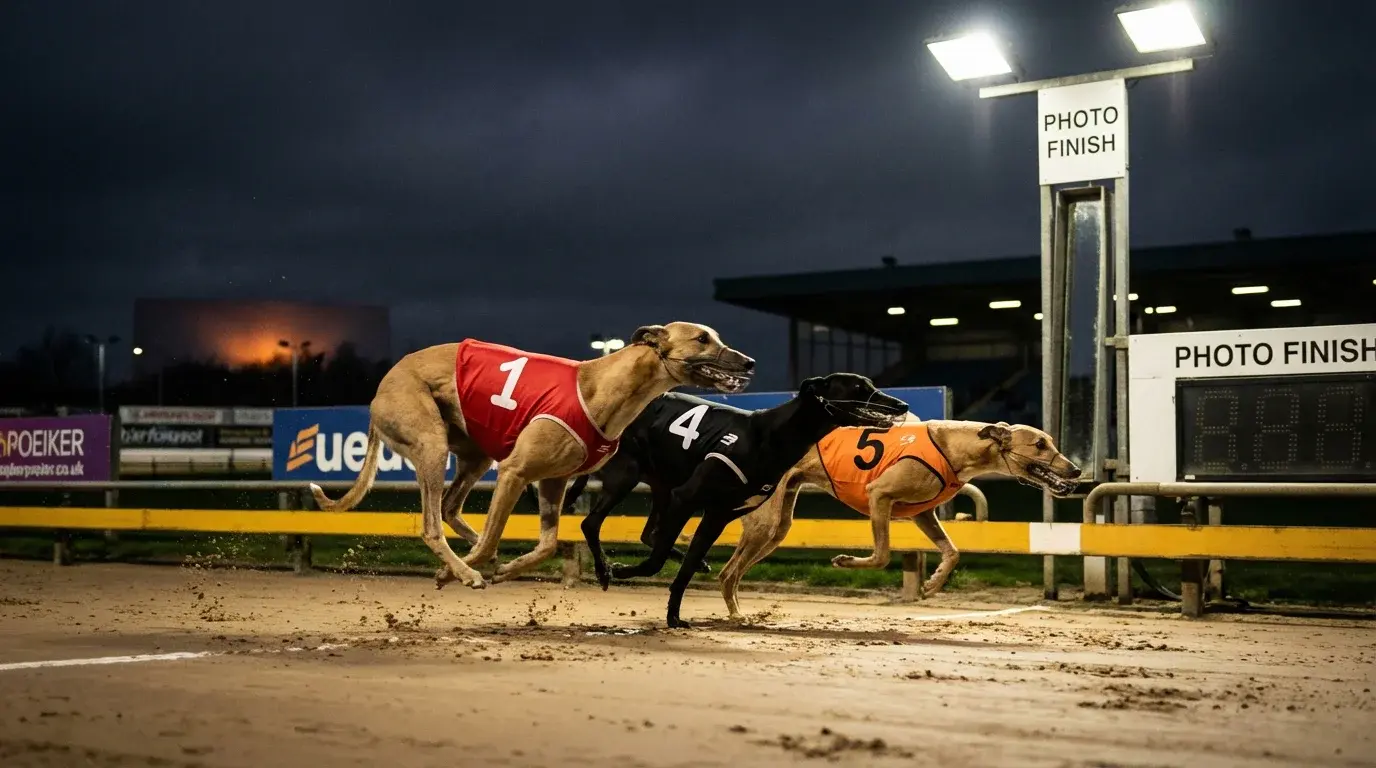
First, second, third in order. Get it right and the returns can be extraordinary. Greyhound tricast dividends regularly pay three-figure sums from a one-pound stake, and on occasion they run into four figures when outsiders fill the places. That potential is what draws punters to tricast betting again and again, even though the strike rate is brutally low.
The appeal is not hard to understand. In a standard six-runner greyhound race, there are 120 possible permutations for the first three finishers in exact order. A straight tricast covers one of those 120. Even allowing for the fact that some permutations are vastly more likely than others, the maths works against you on any individual bet. But the payouts reflect that difficulty, and therein lies the attraction: a single correct tricast can deliver returns that would take weeks to accumulate from win singles.
This guide explains how tricast bets work mechanically, what combination tricasts cost and cover, how dividends are calculated, and how to approach tricast betting with discipline rather than blind optimism. Because while the payouts are real, so is the long run of losers that separates them.
How Tricast Bets Work
A straight tricast requires you to name the first, second and third finishers in exact order. All three must finish in precisely the positions you nominated. If your first pick wins and your second pick finishes second but your third pick finishes fourth, the bet loses. There is no consolation for getting two out of three right. Exactitude is the entire point.
In practical terms, a tricast is available on every standard UK greyhound race with six or more runners. Most BAGS meetings and evening fixtures qualify. The bet is placed by selecting your three dogs in order, nominating each for first, second and third respectively. The minimum stake varies by bookmaker but is typically one pound on a Tote tricast and can be as low as ten pence on bookmaker tricasts.
The return is determined after the race, not before. Unlike a win bet where you know the odds at the point of placing the bet, tricast dividends are calculated using either the computer tricast formula or the Tote pool. The computer tricast uses the starting prices of the first three finishers and a mathematical formula to derive the payout. The Tote tricast distributes the pool among winning tickets after a percentage deduction. Both methods produce a dividend that is unknown until the race finishes and the prices are confirmed.
This uncertainty about the exact payout is part of what makes tricasts both exciting and strategically awkward. You can estimate the likely return based on the pre-race odds of your three selections, but the actual dividend might be significantly higher or lower depending on how the SP settles. A strong late gamble on one of your picks can compress the dividend, while an unexpected drift can expand it.
One important detail: some bookmakers offer fixed-odds tricasts on selected meetings. These work like a standard bet where the return is agreed at the time of placement. The prices tend to be less generous than the CSF tricast dividend, but the certainty can be worth the trade-off, particularly if you are managing stakes carefully and want to know your exact exposure before the race.
Combination Tricasts
Combination tricasts remove the burden of predicting the exact order by covering every possible permutation of your selected dogs across the first three places. The trade-off is stake. Where a straight tricast costs one unit, a combination tricast multiplies quickly.
With three selections, a combination tricast covers six permutations: every possible ordering of three dogs across three positions. A one-pound combination tricast on three dogs costs six pounds. This is the simplest and most common form of combination tricast, and it represents a reasonable middle ground between the precision required for a straight and the cost of wider coverage.
With four selections, the permutations jump to 24. A one-pound unit stake now costs 24 pounds. With five selections, you are covering 60 permutations at sixty pounds per unit. The full-cover combination tricast on all six dogs in a race covers all 120 permutations and costs 120 pounds at a one-pound unit. At that point, the dividend needs to be substantial to show any profit, and in races involving short-priced runners, it frequently is not.
The key decision with combination tricasts is how many dogs to include. Three selections at six units is manageable and profitable if you can consistently identify three dogs likely to fill the frame. Four selections at 24 units is viable if you have strong form analysis but cannot separate one of the four for elimination. Going beyond four selections is almost always a negative expected-value proposition unless the race is genuinely wide open and you expect an outsider-heavy result with a correspondingly large dividend.
A useful compromise is the banker tricast, available with some bookmakers. You nominate one dog as a banker to finish first, and then select two or more other dogs to fill second and third in any order. This reduces the number of permutations because the first position is fixed. Banking one dog with two others in a combination for second and third gives you just two permutations instead of six, cutting your stake by two-thirds while still covering the uncertainty in the minor places.
Tricast Dividend Calculation
The computer straight tricast formula uses the starting prices of the first, second and third finishers to generate the dividend. The exact formula is not published in a simple public-facing format by most operators, but the principle is straightforward: longer-priced finishers in the placings produce larger dividends, and shorter-priced finishers produce smaller ones.
To illustrate the range, consider two scenarios from a typical six-runner greyhound race. In the first scenario, the 2/1 favourite wins, the 3/1 second favourite finishes second, and the 4/1 third favourite runs third. The tricast dividend here might be in the region of 30 to 50 pounds for a one-pound stake. The market predicted the result reasonably well, so the payout is modest by tricast standards.
In the second scenario, a 10/1 outsider wins, a 6/1 shot finishes second, and the 8/1 runner comes third. Now the tricast dividend could run to 500 pounds or more for the same one-pound stake. The market did not predict this result, the combination was unlikely, and the payout reflects that improbability.
Tote tricast pools work differently. All stakes go into a pool, the Tote takes a deduction, normally 29.9 percent across all greyhound pools, and the remainder is shared among winning ticket holders. In races with large pools and few winning tickets, the Tote tricast can significantly outpay the computer tricast. In races with small pools, the reverse is often true. Checking both options, where available, before placing your tricast is a habit worth developing.
When to Bet Tricasts
Tricasts are not appropriate for every race, and knowing when to use them is as important as knowing how they work. The ideal tricast race has a few specific characteristics that make predicting the first three more tractable than usual.
Class differentials are the first thing to look for. A graded race where two or three dogs are clearly superior to the rest of the field narrows the likely frame occupants considerably. If you can confidently eliminate two or three dogs from contention for the first three places, the remaining permutations become more manageable.
Pace maps help refine the picture further. A race where one dog has clearly the best early speed and is drawn on the rail is a candidate for a banker tricast, with that dog nominated for first. If you can then identify two dogs likely to run on for the minor places based on their closing speed and running style, the bet starts to look less like a lottery and more like an informed position.
Trap draw compatibility matters too. A race where your three fancied dogs are drawn in positions that give them clear running lines is more likely to produce a formful result than a race where two of your picks are drawn side by side and might bump at the first bend. Interference is the enemy of tricast betting because it introduces randomness into the finishing order that even excellent form analysis cannot account for.
Avoid races where the field is genuinely competitive and open. If all six dogs have a realistic chance of finishing in the first three, the number of possible outcomes is too large for any tricast to represent good value. These races are entertaining to watch but poor tricast propositions. Save your tricast stakes for the races where your analysis gives you a genuine narrowing of the field.
Realistic Expectations
Tricast betting has a strike rate that will test even the most disciplined punter. Landing two or three tricasts in a week of heavy BAGS betting would be a strong result. Going a week or two without a single winner is entirely normal. If your bankroll and temperament cannot absorb losing streaks of twenty, thirty or more consecutive tricast bets, this bet type is not for you.
The maths supports tricast betting as a profitable strategy only if you are getting the right prices when you do win. A tricast that pays 40/1 needs to hit roughly once in every 40 attempts to break even at level stakes. If your analysis gives you a genuine edge in identifying the first three, and the resulting dividends consistently exceed what you would expect based on the true probabilities, tricasts can contribute positively to your overall returns. But the variance is enormous.
Staking discipline is non-negotiable. Flat stakes at a level that represents a small fraction of your bankroll is the only sensible approach. Increasing stakes after a losing run in the hope of recovering losses is the fastest route to a depleted account. The big tricast dividend is coming, but you have to be still in the game when it arrives.
Treat tricasts as a supplement to your main betting activity, not the foundation of it. A punter who makes steady returns from win singles and each way bets and adds occasional tricasts on races that fit the criteria described above will have a better experience, and better long-term results, than a punter who bets tricasts on every race hoping for a life-changing payout.
Worth the Difficulty
Tricast betting in greyhound racing occupies a space that rewards genuine skill and punishes speculation. The six-runner field gives you a manageable number of possibilities. The pace-driven, trap-dependent nature of the sport gives you tools to narrow those possibilities. The payouts, when they land, compensate for the difficulty.
None of that makes it easy. But the punters who approach tricasts with proper analysis, realistic expectations and disciplined staking find that the occasional big dividend more than justifies the patience required between winners. The key is treating each tricast as a calculated position rather than a hopeful punt. Precision is what this bet type demands, and precision is what it rewards.
Find more bet type guides at greyhoundoddschecker.
Also read our greyhound forecast betting.
