 Available in US
Live Greyhound Odds: In-Play Betting on Dog Racing UK Real-Time Greyhound Markets Live odds move fast. In greyhound racing they move faster than in almost any o
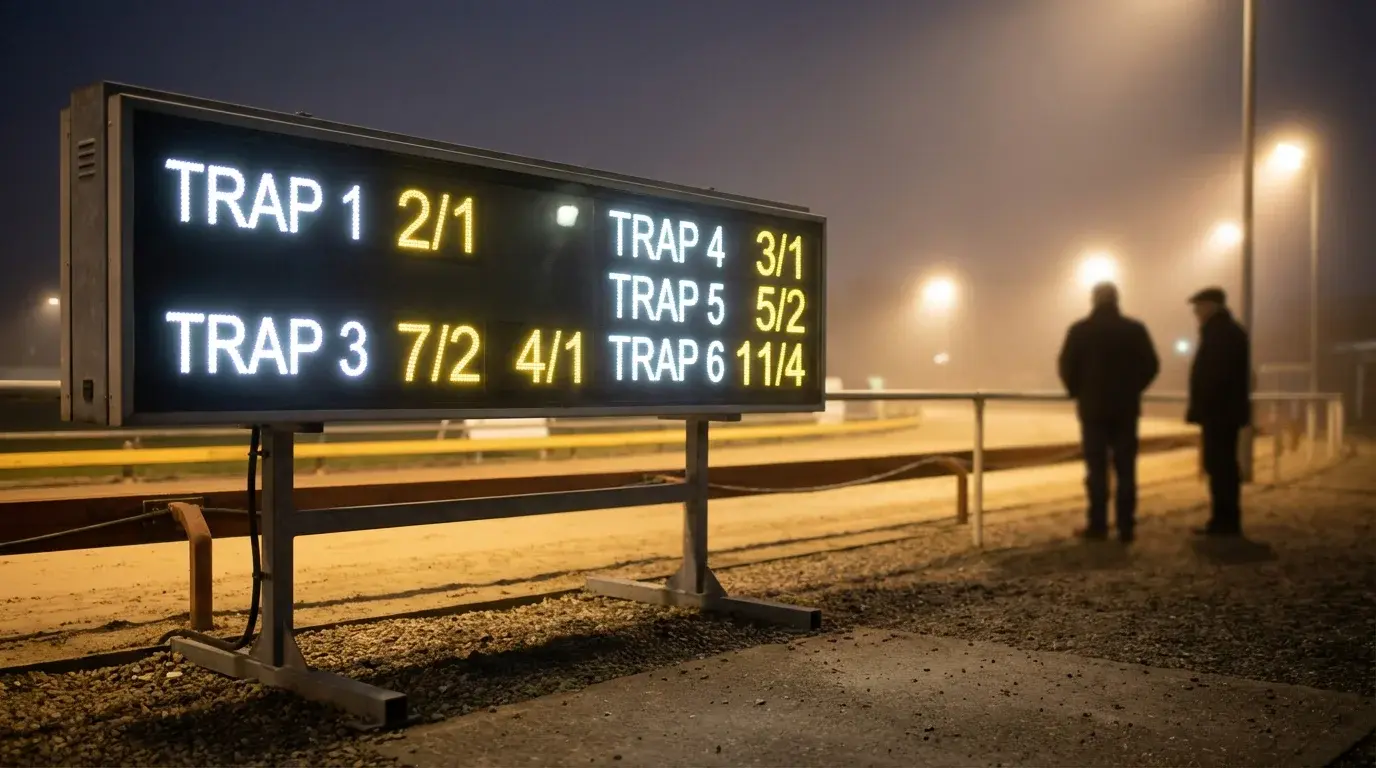
Real-Time Greyhound Markets
Live odds move fast. In greyhound racing they move faster than in almost any other betting market. A dog that opened at 4/1 in the morning can be 7/2 by early evening and 3/1 by the time the hare passes the traps. That volatility is both a hazard and an opportunity. If you understand why prices change and how to read the direction of movement, you can time your bets to capture better value than the punter who just takes whatever price happens to be showing when they glance at the screen.
Greyhound markets are thin compared to football or horse racing. Fewer punters, smaller pools, less money overall. That thinness is what makes them volatile: a single large bet can shift the odds on a runner by a full point or more. The same thinness also means that mispricings persist longer than they would in a heavily traded market, because there are fewer sharp bettors correcting them. For the punter who pays attention to live odds movement, this creates windows of value that do not exist in busier sports.
This guide covers how live greyhound odds function, what drives the movements you see on screen, and how to use real-time market information to make better-timed betting decisions.
How Live Odds Work
Live greyhound odds are displayed and updated in real time on bookmaker websites and odds comparison platforms. The prices you see are the current offer from each bookmaker, and they change continuously in the minutes leading up to a race. Once the traps open, pre-race betting closes. Unlike football, there is no meaningful in-play market for greyhound races because the events last roughly thirty seconds from trap to line.
Bookmakers set their initial prices based on form, draw and grading data, often using algorithmic models that generate a tissue price for each runner. These opening prices go live when the market is first published, typically a few hours before the meeting. From that point, the odds adjust in response to the money coming in. When punters back a particular dog, the bookmaker shortens that dog’s price and pushes out the prices on the other runners to maintain their margin.
The most intense price movement happens in the final five to ten minutes before a race. This is when the majority of betting activity occurs. Professional punters, kennel connections and tipster followers all tend to place their bets late, and the combined weight of that money produces rapid, visible shifts in the odds. A market that looked stable all afternoon can transform completely in the closing minutes.
Odds comparison sites like Oddschecker display the live prices from multiple bookmakers simultaneously. These tools are invaluable for spotting discrepancies between firms. One bookmaker might have your dog at 7/2 while another still shows 4/1 because their traders have not yet reacted to the same flow of money. That gap is where alert punters find value, and it closes quickly once the broader market catches up.
SIS, the sports information services provider, distributes live greyhound coverage to bookmakers across the UK. The SIS feed includes real-time market data alongside the video stream, which is how on-course betting activity at the track feeds through to the online bookmaker prices. Understanding that this link exists helps explain why online prices sometimes shift suddenly in response to activity that is not visible on any comparison site: money placed at the track itself drives changes that ripple outward.
Reading Market Movements
Not all price movements are created equal. A dog drifting from 3/1 to 7/2 over the course of an afternoon is a gradual adjustment, often reflecting nothing more than the bookmaker rebalancing their book. A dog shortening from 5/1 to 3/1 in the final two minutes before the off is a signal. Something is driving that money, and the speed and size of the move tells you how seriously to take it.
The direction of movement is your first piece of information. Shortening prices mean money is coming for that dog. Lengthening prices, known as drifts, mean money is going elsewhere. The rate of change adds context. A gradual drift over an hour is market noise. A sharp drift in the final minutes suggests informed money has assessed this dog and moved on.
The second piece of information is correlation across bookmakers. If one bookmaker shortens a dog from 4/1 to 3/1 but all others remain at 4/1, the movement may simply reflect that one firm’s exposure. If all bookmakers shorten simultaneously, the market as a whole is receiving a signal. Cross-referencing prices on a comparison site reveals this pattern instantly.
Volume matters but is harder to assess from the outside. Bookmakers do not publish the amount of money placed on each selection. What you can observe is the magnitude and speed of odds changes, which serve as a proxy for volume. Large, fast moves indicate significant money. Small, slow moves indicate routine adjustment. Learning to distinguish between the two takes time and observation, but it is a skill that directly improves your betting timing.
Market sentiment can occasionally mislead. Tipster-driven moves are a common feature of greyhound markets. When a popular tipster publishes a selection, their followers pile in and the price collapses. This looks identical to an informed gamble on the odds screen, but the driving force is different. Tipster followers may be backing on reputation rather than independent analysis, and the resulting price may not reflect the dog’s true chance accurately. Distinguishing tipster-driven moves from genuine informed money is difficult in real time but becomes easier if you track which meetings and races tend to attract tipster activity.
Steam Moves and Drifters
A steam move is a rapid, significant shortening in a dog’s price, typically occurring in the final minutes before a race. The term comes from horse racing but applies equally to greyhound markets. When a dog steams in from 6/1 to 3/1 in the space of two or three minutes, it usually indicates that substantial money from confident sources is behind the move.
Steam moves in greyhound racing carry more weight than in many other sports because of the market’s thinness. It takes less money to move a greyhound price than a Premier League football match, but the sources of that money in greyhound racing tend to be closer to the kennels. Trainers, owners and their associates have genuine insight into a dog’s condition, recent trial times and general wellbeing. When their money arrives in the market, it moves prices sharply and often proves correct.
That said, not every steam move is a winning bet. Some are driven by misinformation, wishful thinking or coordinated attempts to manipulate the market on a weak dog. Blindly following every steam move without your own assessment of the race is a strategy that produces short-term excitement and long-term losses. The steam move should be one input among several, not a substitute for doing your own homework.
Drifters are the opposite: dogs whose odds lengthen progressively as the race approaches. A drift from 3/1 to 5/1 tells you that the market has reassessed this dog downward. The reasons might include negative reports from the kennel, a late change in track conditions, or simply a better-fancied rival attracting the money. Drifters are worth watching because a significant drift sometimes pushes a dog’s price beyond its true value. If you had already identified the dog as a contender and the drift takes the odds to a level that offers genuine value, the market may have overcorrected, and the price now represents an opportunity.
Timing Your Bet in Live Markets
The optimal time to place a greyhound bet depends on what you are trying to achieve and whether your bookmaker offers best odds guaranteed. With BOG, the timing decision is simple: take an early price and let the guarantee protect you. The earlier you bet, the more runway there is for the price to drift in your favour, and BOG ensures you never receive worse than the price you took.
Without BOG, timing becomes a genuine strategic decision. Betting early locks in a price before the market moves, but you accept the risk that the price might drift higher after your bet is placed. Betting late gives you the benefit of market information but risks missing a price that shortens before you act. The compromise position for most punters is to wait until the final five to ten minutes, observe the initial direction of movement, and then commit. By that point, the major money has usually arrived and the market shape is largely set.
One practical approach is to set a target price. If your analysis says a dog at 4/1 offers value but not at 3/1, watch the market and only bet if the price reaches or exceeds your threshold. If the dog opens at 7/2 and drifts to 4/1, you have your bet. If it opens at 7/2 and shortens to 5/2, you walk away. This discipline prevents you from chasing bets at prices that do not represent value, which is one of the most common leaks in any greyhound punter’s approach.
Avoid betting in the final thirty seconds unless you are confident in what you are doing. Prices in the last half-minute can be volatile and bookmakers may not accept bets quickly enough for the price you clicked on to be the price you actually receive. Some operators quote a slightly different price or reject the bet entirely if the market has moved while your request is being processed. Late betting also removes your ability to react to any further information or price change.
In-Play Betting Limitations
In-play betting on greyhound racing is essentially non-existent in any meaningful sense. A race lasts approximately thirty seconds, and the field covers less than 500 metres at most standard distances. There is no half-time interval, no break in play, and no point during the race where a bookmaker can realistically offer updated odds and accept bets.
Some bookmakers technically keep their markets open for a brief moment after the traps open, but this is a legacy of system design rather than a deliberate in-play offering. The prices available, if any, are unlikely to reflect the actual state of the race, and the practical window for placing a bet is measured in seconds at best. Do not plan a greyhound betting strategy around in-play opportunities. They do not exist in any useful form.
What does exist, and what serves the same analytical purpose, is live streaming. Several major bookmakers offer live video streams of greyhound races through their platforms, powered by SIS coverage. Watching the live stream gives you visual information that the raw odds data cannot provide: how a dog breaks from the traps, how it handles the first bend, whether it shows early pace or runs on from behind. This information is not useful for betting on the race you are watching, since it is already underway, but it is extremely useful for assessing the same dog in future races. Building a mental picture of running styles through live observation is a form of homework that pays dividends over time.
Speed and Precision
Greyhound markets reward punters who watch carefully and act decisively. The live odds on your screen are a compressed stream of information about what the broader market thinks will happen in the next thirty seconds. Every shift in price is a data point, and the punters who learn to read that data consistently outperform those who bet on instinct alone.
The edge is not dramatic. It is measured in slightly better prices taken at slightly better moments, compounded across dozens of bets per week. But in a sport where margins are slim and races are over in half a minute, that incremental advantage is the difference between a punter who grinds out steady returns and one who churns through their bankroll wondering where it all went.
Find the latest odds at greyhoundoddschecker.
Also explore our odds guide.
