 Available in US
English Greyhound Derby Betting: Odds, History and Tips The English Greyhound Derby The English Greyhound Derby is the single biggest event in British dog racin
The English Greyhound Derby
The English Greyhound Derby is the single biggest event in British dog racing. It is the race every owner, trainer and greyhound aims for, the one title that defines a career. For punters, the Derby represents something equally significant: a concentrated period of high-quality racing with ante-post markets, deep betting liquidity and the kind of analytical depth that only a major tournament provides.
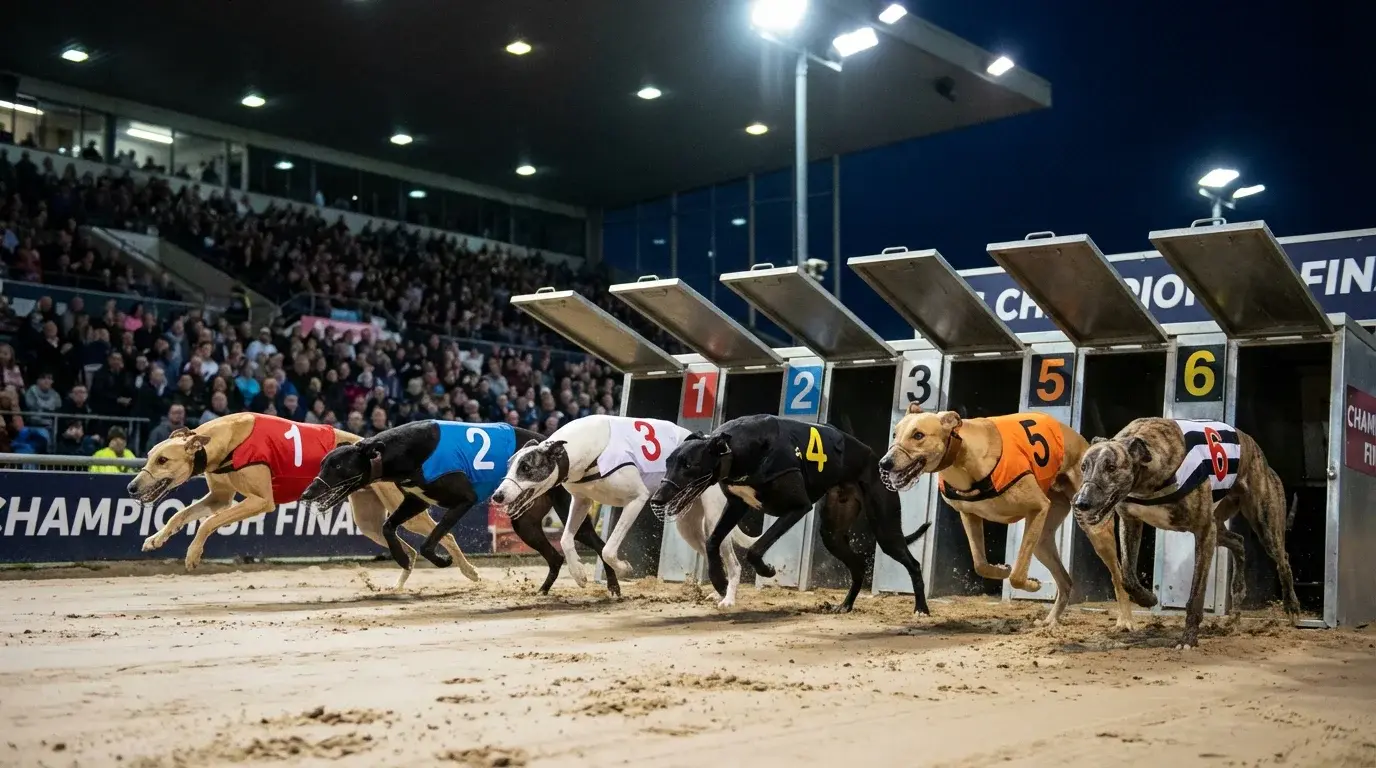
The Derby runs annually, typically in the late spring or summer, and the competition unfolds over several rounds of heats before culminating in a six-dog final. The format produces weeks of racing that reward close attention, because each round reveals new information about the contenders: their form, their draw preferences, their ability to handle the specific demands of the host track, and their temperament under competitive pressure.
This guide covers the Derby’s history, its competition format, the ante-post betting markets, notable past winners and the strategic approaches that give punters the best chance of finding value across the event.
Derby History and Prestige
The English Greyhound Derby was first staged in 1927, the year after greyhound racing arrived in Britain. It was held at White City in London, a venue that would host the event for decades and cement its status as the sport’s most prestigious fixture. The Derby quickly established itself as the championship event, attracting the fastest and best-bred dogs from across the UK and Ireland.
The race moved through several venues over the decades as stadiums closed and the sport’s geography shifted. Wimbledon hosted the Derby for a long period and became synonymous with the event, before the stadium’s closure forced another relocation. Towcester in Northamptonshire is the current home, bringing the Derby to a modern facility in the Midlands with a track layout that tests the full range of a greyhound’s abilities.
The prize money reflects the event’s standing. The Derby final carries the largest purse in UK greyhound racing, and the total prize fund across all rounds makes it the most lucrative competition in the sport. For trainers and owners, winning the Derby is the pinnacle. For bettors, the prestige attracts quality fields that make the form analysis both more demanding and more rewarding than standard graded racing.
Irish-trained dogs have historically performed well in the English Derby, adding an international dimension to the competition. The cross-Channel rivalry between English and Irish kennels is a feature of the event that enriches the form puzzle and creates additional analytical angles for punters who follow both circuits.
Competition Format
The Derby is run as a knockout competition over multiple rounds. The precise format can vary slightly from year to year, but the standard structure involves initial heats, quarter-finals, semi-finals and a six-dog final. Each round takes place on a separate race night, with the competition spanning several weeks from the first heat to the showpiece final.
The initial heats feature a large entry field divided into groups. Dogs must finish in the qualifying positions to advance to the next round. This format means that every race matters and there is no safety net for a below-par performance. A dog that suffers interference or a poor break in a heat can be eliminated regardless of its overall quality. This knockout element is what makes the Derby both thrilling and strategically complex for bettors.
As the rounds progress, the quality of the fields intensifies. Dogs that have survived the heats and quarter-finals have proven their form at the track and their ability to handle the pressure of competitive racing. By the semi-final stage, the six-to-twelve remaining dogs are typically the cream of the entry, and the form lines between them become the central puzzle for punters assessing the final.
The trap draw for each round is conducted independently, and the draw can significantly influence outcomes. A dog that draws Trap 1 in the semi-final has a different proposition from the same dog drawn in Trap 6. Because the Derby is run over a standard distance rather than a marathon trip, the draw retains its importance even at a larger-circumference track like Towcester. Following the draw closely as each round is announced is essential for adjusting your assessment of each contender’s chance.
Ante-Post Derby Betting
The ante-post markets are where much of the betting interest concentrates around the Derby. Bookmakers open odds on potential Derby contenders weeks before the competition begins, sometimes as early as the entry announcement. These early markets offer the largest prices and the greatest potential for finding value, because the form picture is incomplete and the bookmakers are pricing based on reputation and limited recent data.
Ante-post betting carries a specific risk: if your selection does not compete in the race, you lose your stake. There is no refund for withdrawals, injuries or failure to qualify through the heats. This rule is non-negotiable and applies regardless of the reason for the dog’s absence. A dog that is the ante-post favourite and then picks up an injury in training two days before the final still results in a lost bet for anyone holding an ante-post ticket.
The risk is real, but it is priced in. Ante-post odds are longer than the prices available on the day of the final because the bookmaker is compensating for the possibility of non-runners. A dog at 10/1 ante-post might be 6/1 on the morning of the final after successfully navigating every round. The punter who backed at 10/1 has captured four additional points of odds as payment for carrying the risk through the competition.
Timing your ante-post bet is a judgement call. Betting before the heats secures the longest prices but carries the highest risk of elimination. Betting after the first round reduces the risk because your dog has demonstrated it can handle the track and the competition, but the prices will have shortened. Betting after the semi-finals offers the most information but the shortest prices. There is no universally correct answer, and different punters will find different points on the risk-reward curve comfortable.
Notable Previous Winners
The Derby roll of honour reads as a history of the sport’s greatest greyhounds. Dogs like Mick the Miller, who won back-to-back Derbies in 1929 and 1930, established the event’s prestige and captured public attention beyond the racing community. Patricia’s Hope won consecutive Derbies in 1972 and 1973, a feat that remains one of the most celebrated achievements in the sport.
More recent decades have produced champions that punters who follow the modern circuit will recognise. The standard of competition has evolved, with Irish-trained dogs increasingly prominent in the later rounds. The cross-border element adds a layer of complexity because form from the Irish circuit does not always translate directly to English tracks, and assessing Irish raiders requires knowledge of both racing systems.
Studying previous Derby winners reveals patterns that inform current betting. Consistent themes include the importance of early pace in the final, the value of experience from earlier rounds at the host track, and the tendency for dogs that won their semi-final impressively to carry that form into the final. Dogs that scraped through the semi-finals or were compromised by the draw tend to face an uphill task in the final, though exceptions exist.
The betting market around previous Derby finals also provides useful reference points. Favourites have a solid but not overwhelming record in the final, reflecting the difficulty of predicting the outcome of a six-dog race where every runner is an elite performer. Prices between 2/1 and 5/1 for the final winner are typical, and longer-priced winners at 8/1 or beyond are not uncommon. The six-runner field keeps the number of possible outcomes manageable, but the quality of every dog in the final makes upsets a genuine possibility.
Derby Betting Strategy
The most productive Derby betting strategy combines ante-post positions with round-by-round assessment. Start by identifying three or four dogs from the entry that you believe have the speed, stamina and temperament to reach the final. Back one or two of them ante-post at the longest available prices, accepting the risk of elimination in exchange for enhanced odds.
As the competition progresses, use each round to refine your assessment. A dog that wins its heat impressively, posting a fast time from a favourable draw, tells you one thing. The same dog winning from an awkward draw tells you more. Pay attention to how dogs handle the specific track, because the host venue’s characteristics filter out contenders that do not suit its layout. By the semi-final stage, you should have a clear picture of which dogs are running to their best and which are scraping through on quality alone.
The final itself presents a unique betting challenge because every dog in the field is an elite performer. The standard capping approach does not apply here: there are no obvious weak links to eliminate. Instead, focus on the draw, recent form at the track, and the pace dynamics of the specific final field. Which dogs will lead? Which will be closers? Does the draw favour the front-runners or give the closers a chance to settle and finish strongly?
Consider the each way market in the final. At prices typically between 2/1 and 8/1 for each of the six finalists, the each way value can be significant on the right dog. A dog at 6/1 that you assess as having a 25 percent chance of placing offers genuine each way value, even if its outright win chance is slimmer. The final is a single race where anything can happen in thirty seconds, and the each way safety net protects you against the randomness that even the best analysis cannot eliminate.
The Ultimate Prize
The English Greyhound Derby is the one event in the calendar where every strand of greyhound betting comes together: ante-post speculation, form analysis across multiple rounds, trap draw assessment, pace mapping for the final, and the discipline to hold or adjust positions as new information emerges. It rewards the punter who pays attention throughout the competition, not just on final night. The thirty seconds of the Derby final are the culmination of weeks of preparation, for the dogs and for the punters who back them.
Find more race guides at greyhoundoddschecker.
Also read our greyhound St Leger betting.
