
Best Greyhound Betting Sites – Bet on Greyhounds in 2026
Loading...
The Hidden Data in Sectional Times
A greyhound’s finishing time tells you how fast it ran. Sectional times tell you how it ran: where it accelerated, where it sustained, and where it faded. That distinction is the difference between reading the scoreboard and reading the race. A dog that posts 29.50 seconds for 480 metres has delivered one number. A dog that posts 4.10 to the first bend and 25.40 for the remainder has told you something about its racing character that the overall time alone cannot convey.
Sectional analysis is one of the most underused tools in greyhound betting. Most casual punters glance at overall race times and finishing positions without considering the split data that reveals how the race actually unfolded. The information is there for anyone who looks, and it provides an analytical edge that goes beyond what raw form figures offer.
This guide explains what sectional times are, how to read them, why early pace matters as much as it does, and how to incorporate split data into your betting decisions.
What Are Sectional Times
Sectional times are recorded splits at specific points during a greyhound race. The most common sectional in UK greyhound racing is the split to the first bend, often called the run-up time or the first-sectional. This measures how many seconds elapse from the moment the traps open until the dogs reach a timing beam positioned at or near the first bend. The remaining time from the first bend to the finish is then calculated by subtracting the sectional from the overall time.
Not all tracks publish sectional times in the same format. Some tracks provide a single first-bend split. Others provide multiple sectionals at different points around the circuit, giving a more detailed picture of how the race played out at each stage. The depth of available sectional data varies by venue and by the technology installed at the track.
The first-bend sectional is the most useful single piece of speed data because it captures the most critical phase of the race. The opening strides from the traps to the first turn are where races are won and lost in greyhound racing. A dog that records a fast first sectional has broken quickly, established position, and enters the first bend with momentum. A dog with a slow sectional has been outpaced, is likely to encounter traffic, and must make up ground through the remainder of the race.
Sectional times are typically recorded to hundredths of a second, and the differences that matter are small. A tenth of a second at the first bend translates to roughly a length at racing speed. Two-tenths is two lengths. In a six-dog field travelling at 40 miles per hour into a bend, those lengths determine who gets the rail, who gets checked, and who races in clear air. The numbers are small but the consequences are large.
Reading Split Times
The raw sectional number means little without context. A first-bend split of 4.05 seconds is fast at one track and slow at another, because the distance from traps to the timing beam varies between venues. You must compare sectionals within the same track and distance, not across different tracks.
Within a single track, the sectional data becomes highly informative. Compare a dog’s first-bend split against the average for that track and distance. A dog that consistently records first-bend times half a second faster than the field average is a confirmed early-pace runner. A dog that consistently records times half a second slower is a confirmed closer. Knowing which category each runner falls into allows you to map the likely pace scenario for any race before it happens.
The second half of the race, the time from the first bend to the finish, reveals a different quality: sustained speed and stamina. A dog that is fast to the bend but slow from the bend to the line may be flattered by its early position. It gets to the front, but it fades. Conversely, a dog that is moderate to the bend but posts a rapid second sectional is finishing strongly, possibly passing tiring dogs and running into places that its early position did not promise. Both pieces of information are useful, but only if you look at them together.
Run-to-run consistency in sectionals is particularly revealing. A dog that posts first-bend splits of 4.10, 4.08, 4.12 and 4.09 over four consecutive runs is a metronomically consistent breaker. You can rely on this dog to break at a specific speed every time. A dog that posts 4.02, 4.25, 4.08 and 4.30 is unpredictable from the traps. Its early speed depends on something, perhaps its mood, the draw, or the behaviour of the dog in the adjacent trap, and that inconsistency introduces uncertainty that the form figures do not capture.
Why Early Pace Matters
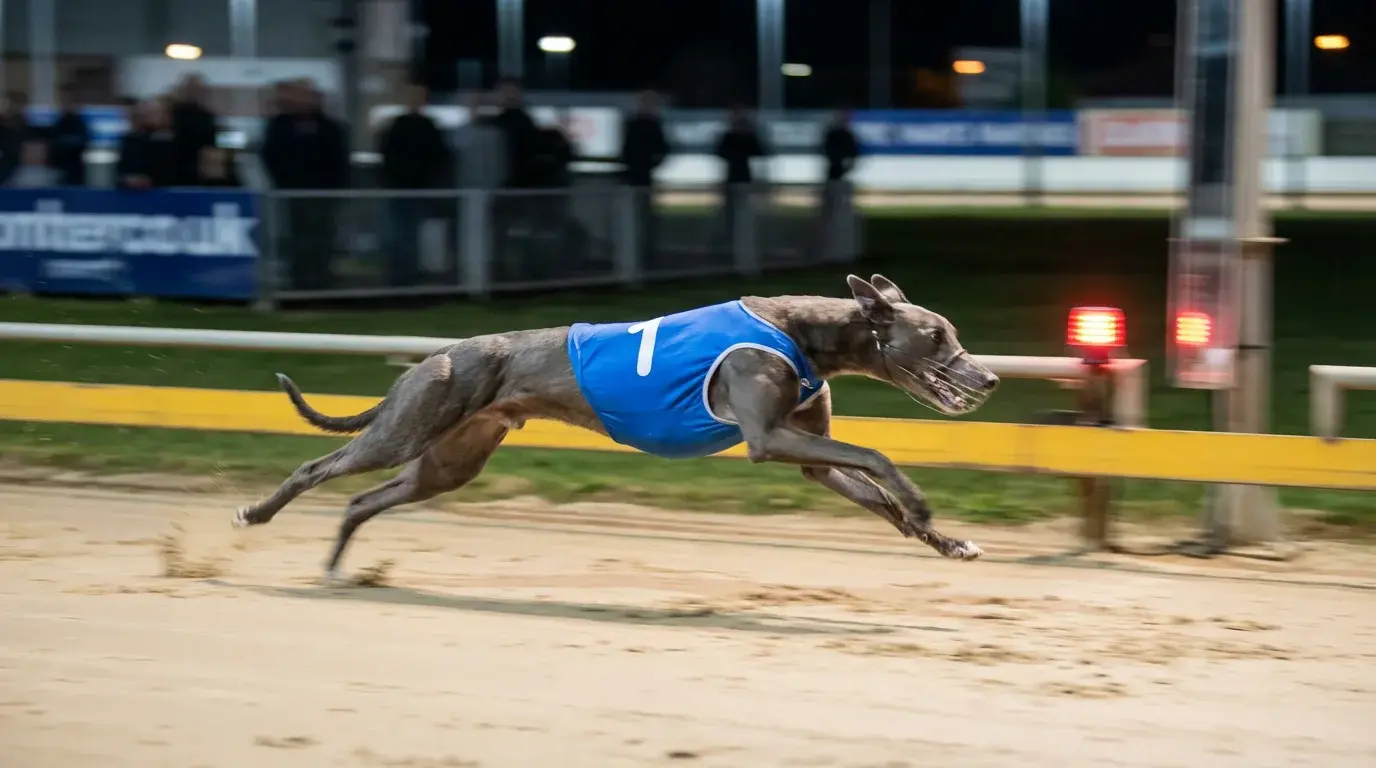
Greyhound racing is a front-runner’s game. Across all UK tracks and distances, dogs that lead at the first bend win a disproportionate share of races. The exact percentage varies by track, but the pattern is universal: being in front early is the single most reliable predictor of winning. The reason is structural. The first bend is a bottleneck where six dogs compress into a narrow racing space. The dog at the front navigates the bend on its chosen line without interference. Every other dog must adjust to the runners around it, and that adjustment costs time, momentum and position.
Early pace is particularly decisive at sprint distances and at tight tracks where the first bend arrives quickly. At a 265-metre sprint, the first bend may account for a third of the total race distance, and a dog that leads at that point has covered the most important section of the race in clear air. At middle distances the advantage diminishes slightly because the extra bends provide more opportunities for positional changes, but the front runner still holds a structural edge throughout.
This does not mean that slow beginners cannot win. Dogs with strong finishing speed can and do pick up front-runners that tire through the bends or fade in the home straight. But the probability favours the early-pace runner in every statistical analysis of UK greyhound results. If you can identify the dog most likely to lead at the first bend, you have identified the most probable winner in the majority of races.
The betting market partially prices in early speed, but it does so imperfectly. A known front-runner drawn in Trap 1 at a tight sprint track will be short, and rightly so. But the market is less efficient at pricing the interaction between early speed and trap draw in more complex situations: a fast breaker drawn in Trap 4 at a larger track, for instance, or a moderate breaker drawn inside a slow starter. These race-specific dynamics are where sectional analysis generates an edge that the headline form cannot provide.
Comparing Times Across Tracks
Direct comparison of sectional times between tracks is unreliable because the measurement points differ. The distance from traps to the first timing beam varies, the track widths differ, and the surface characteristics produce different baseline times. A 4.00-second first-bend split at Track A is not the same as 4.00 at Track B.
What you can compare is a dog’s sectional performance relative to the field average at each venue. If a dog breaks two-tenths faster than the field average at Track A and one-tenth faster at Track B, you know it is a stronger relative breaker at Track A. This relative comparison tells you how the dog is likely to perform at each venue without requiring the raw times to be directly equivalent.
When a dog transfers between tracks, its sectional data from the previous venue provides a guide to its early-speed profile but not a precise prediction of its times at the new track. A consistently fast breaker will likely break fast at any venue, but the exact split will depend on the new track’s trap position, run-up distance and surface. Use the historical sectionals as a character reference rather than a time prediction, and recalibrate once the dog has recorded splits at its new home.
Track records and standard times published by the venue provide a useful benchmark. If the standard first-bend time for 480-metre races at your track is 4.15, and a dog consistently records 4.05, you know you are dealing with an above-average breaker at that venue. These benchmarks give you a fixed reference point against which to measure every dog on the card.
Using Sectionals in Betting
The most direct application of sectional data is pace mapping. Before each race, line up the first-bend sectionals for all six runners. Identify the fastest breaker and the slowest. Consider the trap draw: does the fastest breaker have a clear path to the first bend, or is it drawn where it needs to cross? Does the slowest breaker have traffic to contend with, or is it drawn in space where it can recover?
This exercise produces a mental model of the probable race shape. If the fast breaker is in Trap 1 and the slow breaker is in Trap 6, the race will likely settle early with the leader on the rail and the closer running from behind. If the fast breaker is in Trap 5 and another fast breaker is in Trap 2, there is a higher chance of crowding at the first bend as both dogs vie for position. These scenarios affect the probability of each dog winning and should inform the price you are willing to pay.
Sectional data also helps with forecast and tricast betting. If the two fastest breakers are drawn in traps that give them clear running, a forecast pairing them for first and second is supported by the pace data. If the fastest breaker is drawn on the outside and likely to be checked, a forecast excluding it from the leading position has a stronger basis.
The Clock Behind the Clock
Overall race times get the headlines. Sectional times provide the insight. The thirty seconds of a greyhound race contain layers of data that the finishing time alone cannot express, and the punter who digs into the splits rather than settling for the headline number develops a richer understanding of how races unfold and why. Early speed is not just a number. It is the foundation of positional advantage in a sport where position is everything.