Best Greyhound Betting Sites – Bet on Greyhounds in 2026
Loading...
Across the Irish Sea
Ireland doesn’t just participate in greyhound racing—it lives and breathes it. The sport occupies a cultural position in Ireland that far exceeds its status in Britain. Attendances are higher relative to population, breeding is a national industry centred around the midlands and rural counties, and the Irish Greyhound Derby ranks among the most prestigious sporting events on the island. For UK punters, Irish greyhound racing represents both a rich alternative betting market and a source of talent that frequently crosses the water to compete in British competitions.
Betting on Irish greyhound racing from the UK is straightforward. Most major British bookmakers cover the main Irish meetings, and live streaming through SIS broadcasts brings the action directly to screens. The odds formats are familiar, the bet types identical, and the general principles of form reading, trap analysis, and value assessment transfer directly. What differs are the specifics: track layouts, grading structures, competition calendars, and the culture surrounding the sport.
Understanding those differences matters. A UK punter who approaches Irish racing with assumptions built on British experience will misread certain situations. Track geometries vary. Grading conventions differ. The quality of opposition in equivalent-sounding grades doesn’t always align between the two systems. The sections ahead map these distinctions so that Irish greyhound meetings become an informed addition to your betting repertoire rather than an unfamiliar punt in foreign territory.
Major Irish Greyhound Tracks
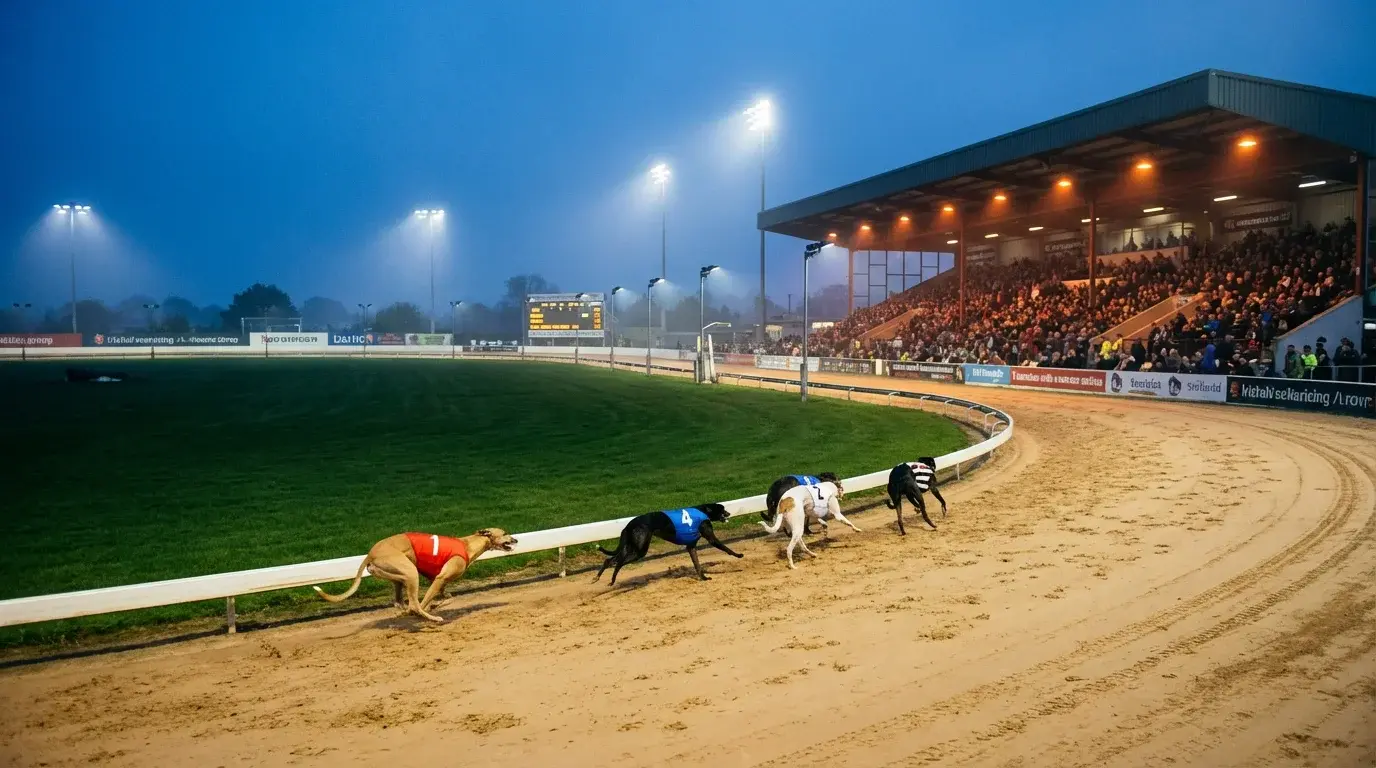
Shelbourne Park in Dublin is the flagship venue of Irish greyhound racing. Situated in the Ringsend area of the city, it hosts the richest meetings on the Irish calendar, including the later stages of the Irish Greyhound Derby. The track runs over 525 and 550 yards, with a tight first bend that rewards early pace from the inside traps. Shelbourne consistently attracts the strongest fields in the country, and its cards are the most widely covered by UK bookmakers.
Curraheen Park in Cork serves as the second major venue. Larger in circumference than Shelbourne, Curraheen’s more galloping layout suits dogs with stamina and sweeping running styles. The track hosts the early rounds of the Derby and several other classic competitions. Its wider bends reduce the first-bend advantage that tighter tracks amplify, creating more open racing where tactical speed matters less than sustained pace.
Limerick, Tralee, Galway, Waterford, Clonmel, Dundalk, Mullingar, and several other venues make up the broader Irish circuit. Each has its own characteristics—Tralee’s tight turns, Galway’s association with the festival atmosphere—but for UK bettors, Shelbourne and Curraheen Park generate the most betting activity and the deepest markets. Smaller tracks appear less frequently on UK bookmaker platforms and typically offer thinner odds coverage.
Rásaíocht Con Éireann, trading as Greyhound Racing Ireland, governs the sport across the Republic. Its website publishes race cards, results, and competition calendars. For UK punters seeking primary-source information on Irish meetings, this is the starting point—particularly for understanding grading systems and entry criteria that differ from British conventions.
Key Differences Between Irish and UK Racing
The most immediately noticeable difference is distance measurement. Irish greyhound racing uses yards; British racing uses metres. The standard middle distance in Ireland is 525 yards, which converts to approximately 480 metres—the same as the standard British 480-metre distance. This means times at many distances are broadly comparable, though track geometry and surface conditions still affect direct comparisons. The Irish Derby, however, is run over the longer distance of 550 yards (approximately 503 metres).
Grading structures operate on different scales. Irish greyhound grading follows a system administered by Greyhound Racing Ireland, using designations that don’t map neatly onto the British A1-A10 framework. Dogs crossing the Irish Sea to race in Britain—or vice versa—undergo re-grading that sometimes places them at a level that doesn’t reflect their true ability. This mismatch creates occasional pricing opportunities, particularly when Irish dogs make their British debut at a grade that underestimates or overestimates their class.
The breeding and training culture in Ireland produces a disproportionate number of the sport’s highest-quality dogs. Irish-bred greyhounds dominate the British Derby and other prestige events with striking regularity. Many dogs are trained in Ireland through their early careers, then transferred to British kennels for specific campaigns. Understanding a dog’s Irish form—including its performances at tracks with different characteristics—adds a layer of context that race cards sometimes fail to convey adequately.
Trap colours follow the same standard in Ireland as in Britain: red, blue, white, black, orange, and black-and-white stripes for traps one through six. The familiarity helps when watching streams or reading race cards, though individual track biases differ substantially from their British counterparts. Shelbourne’s trap one bias, for instance, doesn’t predict anything about Romford’s trap one performance.
Regulation differs in tone rather than substance. Greyhound Racing Ireland operates under Irish government oversight with its own integrity and welfare standards. Doping protocols, kennel inspections, and race-day veterinary procedures follow Irish rather than British frameworks. For betting purposes, the practical impact is minimal—both jurisdictions enforce broadly comparable standards—but it’s worth noting that regulatory decisions in Ireland, such as suspensions or disqualifications, follow their own process and timeline.
The Irish Greyhound Derby
The Irish Greyhound Derby is the single most prestigious greyhound race in Ireland and one of the most important in the world. The competition runs over 550 yards at Shelbourne Park, with early rounds sometimes staged at other venues before the action converges on Dublin for the semi-finals and final. Prize money ranks among the highest in the sport, reflecting its status as the centrepiece of the Irish racing calendar.
For UK bettors, the Irish Derby matters for two reasons. First, it provides an ante-post market in its own right, with British bookmakers pricing the competition from the early rounds onward. Second, it serves as a form guide for the English Derby and other British prestige events. Dogs that perform well in the Irish Derby frequently cross to Britain for subsequent campaigns, and their Irish form—times, running styles, ability to handle pressure rounds—carries directly into British assessments.
The competition typically runs in August and September, creating a natural link to the later end of the British open-race season. Winners of the Irish Derby command immediate respect in British markets, their odds shortening for any subsequent entry. Conversely, dogs that disappoint in Dublin sometimes drift in British ante-post markets even if the reason for their underperformance was circumstantial—a bad draw, crowding on the first bend—rather than indicative of declining ability.
Ante-post betting on the Irish Derby follows the same “all in, run or not” convention as British ante-post markets. The field can be large, the rounds are competitive, and the attrition rate from entry to final is significant. Backing a dog for the Irish Derby is a higher-risk proposition than backing one for a standard open race, but the prices reflect that elevated risk.
Betting Considerations for Irish Racing
Coverage from UK bookmakers varies. The major operators—bet365, Paddy Power, Betfair, William Hill, Coral, Ladbrokes—typically cover Shelbourne and Curraheen Park meetings as standard. Smaller Irish tracks receive spottier coverage. If you want to bet on a Galway Tuesday card, check availability before planning your selections. Some bookmakers cover only selected races rather than the full meeting.
Live streaming access for Irish meetings follows the same SIS-dependent model as UK coverage. A funded account with a streaming-enabled bookmaker usually unlocks Irish greyhound broadcasts, though the schedule isn’t always as comprehensive as the British offering. Evening meetings at Shelbourne are the most reliably streamed. Afternoon meetings at smaller provincial tracks are less consistently available.
Odds quality on Irish racing can be slightly wider than on equivalent UK meetings, reflecting lower liquidity. Bookmakers trade less volume on Irish greyhounds than on British cards, which means their margins may be higher and their prices less competitive. Shopping across multiple operators is particularly important for Irish races, where the spread between best and worst available odds can exceed what you’d typically see on a busy British evening meeting.
Form information for Irish dogs is accessible through Greyhound Racing Ireland’s official channels and through form services that cover both jurisdictions. When assessing an Irish dog’s form, apply the same principles you’d use for British racing but adjust for the distance and track differences noted earlier. A dog with strong form at Shelbourne is racing on a track with specific characteristics that may or may not translate to its next venue, just as Romford form doesn’t automatically predict performance at Towcester.
A Different Tradition, Shared Principles
Irish greyhound racing runs on the same fundamental principles as British racing—six dogs, an oval track, the fastest one wins—but it does so within a distinct sporting culture that produces different dynamics, different competitive structures, and different betting opportunities. The UK punter who treats Irish meetings as a foreign curiosity is leaving value on the table. The one who invests the effort to understand the differences is adding a productive new dimension to their betting portfolio.
The flow of talent between Ireland and Britain means that studying Irish racing also improves your understanding of British competition. Dogs you first encounter at Shelbourne might appear at Towcester months later, and having watched them run in Dublin gives you a perspective that the race card alone won’t provide. That cross-border knowledge isn’t available to most punters, which is precisely why it offers an edge.
Approach Irish racing the same way you’d approach a new British track: study the results, learn the trap biases, understand the track geometry, and build familiarity through observation before committing serious stakes. The learning curve is gentler than you might expect. The racing is excellent. And the betting opportunities, for those willing to look beyond the Irish Sea, are consistently underexplored.