
Best Greyhound Betting Sites – Bet on Greyhounds in 2026
Loading...
Monmore Green: The Midlands Workhorse
Monmore Green in Wolverhampton runs more racing than almost any other greyhound track in the UK. It is the engine room of the BAGS circuit, hosting multiple meetings per week across daytime and evening fixtures that keep the betting shops and online platforms supplied with live dog racing from the Midlands. For punters, that volume is a gift. More races mean more data, more patterns to identify and more opportunities to find value.
The stadium sits in the Black Country, serving a region with deep roots in greyhound racing. While it may lack the metropolitan glamour of a Romford evening card, Monmore compensates with reliability. The track surface is well maintained, the fields are consistently competitive at every grade level, and the form holds up well enough for analytical punters to build a profitable approach around this single venue.
This guide profiles Monmore in detail: the track dimensions, the distances available, the trap bias data that shapes every race, and practical betting advice for punters who want to make this track a regular part of their portfolio.
Track Profile and Layout
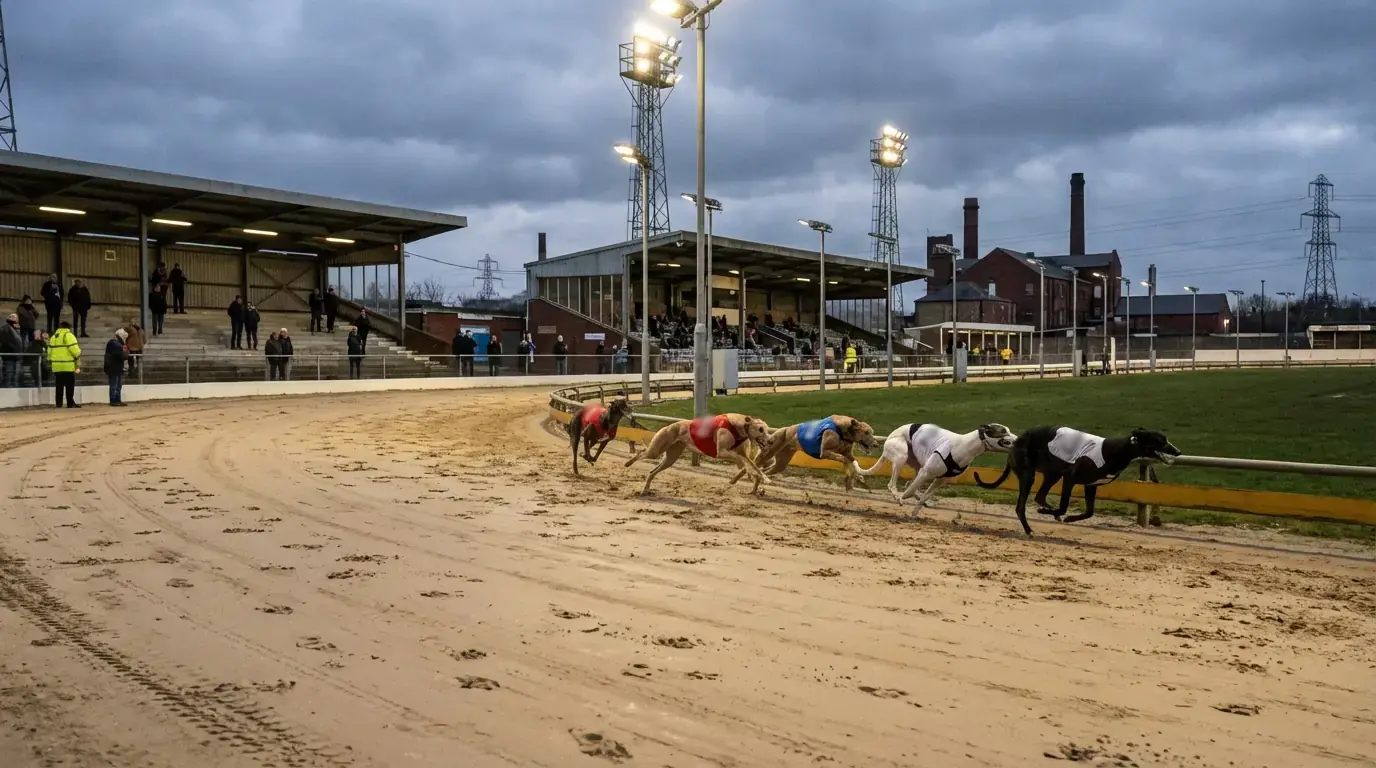
Monmore is a standard four-bend oval with a medium-sized circumference that sits between the tight compactness of Romford and the more spacious layouts found at tracks like Perry Barr. The bends are sweeping rather than sharp, which allows dogs to carry speed through the turns without the abrupt deceleration that tighter circuits demand. This characteristic rewards dogs with balanced running styles rather than pure early-speed specialists.
Sand underfoot, maintained to a consistent depth, produces reliable going across most weather conditions. Monmore’s surface drains adequately in wet weather, though persistent heavy rain can slow times and alter the running characteristics, particularly on the bends where standing water accumulates first. The racing manager adjusts the programme when conditions deteriorate significantly, but abandonments are relatively infrequent.
The run from the traps to the first bend is moderate, giving dogs time to find their stride before the first turn arrives. This is a meaningful difference from Romford, where the first bend comes up almost immediately. At Monmore, a dog that breaks a fraction slow has a reasonable chance of recovering position before the field commits to the turn. The racing is still front-loaded in the sense that early pace matters, but the punishment for a slow start is less absolute here.
The home straight is a decent length, giving closers an opportunity to pick up places on the run to the line. This produces tighter finishes than you typically see at sprint tracks, and it means that dogs drawn wider have a more realistic path into the money even if they lose ground through the first bend. For the bettor, this translates into slightly more open racing and a wider spread of plausible outcomes per race.
Distances and Race Types
Monmore offers a range of distances that covers sprint through to middle-distance racing. The core programme revolves around the 264-metre sprint and the 480-metre standard distance, with occasional races at extended trips for stayers.
The 264-metre sprint is a short, sharp test that covers roughly half a lap. Early speed and trapping are paramount at this distance. There is no opportunity to recover from a slow break or a wide run through the first bend. Sprint form at Monmore is among the most predictable on the UK circuit because the small number of variables makes analysis straightforward: which dog has the best early speed, and which trap gives it the cleanest run to the bend.
The 480-metre standard distance is where the majority of graded racing takes place. Two full laps offer a more complete test of a dog’s ability, combining early pace with stamina and the skill to negotiate four bends cleanly. Form at 480 metres is reliable and well documented, thanks to the sheer number of races run at this trip every week. Punters who specialise in Monmore’s standard-distance card can accumulate a deep understanding of the regular runners and their tendencies.
Stayers’ races at 630 metres and beyond are less frequent but provide a change of pace on feature cards. The longer distances reveal different qualities in the dogs, particularly stamina and the ability to maintain position through multiple bends. The form base at staying trips is thinner, which can produce less predictable results and occasionally larger-priced winners.
Graded racing at Monmore runs from the lower grades through to open company. The racing manager grades dogs based on recent performance at the track, and the system produces well-matched fields in the lower and middle grades. Open races feature the best dogs and attract the strongest betting markets, but the mid-grade races are often the most fertile ground for finding value because they receive less scrutiny from the broader market.
Monmore Trap Bias Analysis
Trap bias at Monmore is present but less extreme than at tighter tracks like Romford. The inside traps carry a general advantage, particularly at sprint distances, but the degree of that advantage is moderate rather than dramatic. This is a consequence of the track’s more generous bend radius, which reduces the positional advantage of the rail compared to circuits where the turns are tighter.
At 264 metres, Trap 1 performs above its expected share of wins, and Trap 6 performs below. The pattern follows the standard inside-to-outside gradient seen at most UK tracks, though the differential is not as sharp as at venues where the first bend comes up more quickly. Traps 2 and 3 also perform well at sprint distances, benefiting from a short angle to the rail without being squeezed against it.
At the standard 480-metre distance, the bias flattens considerably. All six traps produce win rates that sit closer to the expected average of roughly 16.7 percent per trap. Inside runners still have a marginal edge, but outside traps at Monmore are not the liability they can be at tighter circuits. A strong dog drawn in Trap 5 or 6 has a genuine chance if it possesses the early speed to hold its position through the first bend and the stamina to sustain through the second lap.
Seasonal and weather-related shifts affect the bias. Wet conditions tend to favour inside runners because the rail provides a cleaner line through the bends when the surface is holding water. Dry, fast conditions reduce the inside advantage and allow wider runners to carry their speed. Monitoring recent results and paying attention to the going report before a meeting is a simple habit that adds value to any Monmore analysis.
Betting at Monmore
Monmore’s high meeting frequency means there is always racing to bet on, but the depth of the betting market varies between fixture types. Evening meetings and selected feature cards attract the fullest range of bookmaker prices, while daytime BAGS meetings may be covered by fewer operators with wider margins. For the punter seeking the best prices, concentrating activity on the meetings with the deepest markets is a structural advantage.
Best odds guaranteed is available on Monmore races from several major bookmakers, though coverage can be inconsistent on daytime BAGS fixtures. Checking whether BOG applies before placing an early-price bet is a ten-second habit that prevents unpleasant surprises. On meetings where BOG is active, the advice is straightforward: take the early price and let the guarantee work.
The volume of racing at Monmore creates opportunities for punters who track form closely. Dogs run frequently at this track, often racing every week, which generates a rich form profile that reveals tendencies, preferences and performance patterns. A dog that has run ten times at Monmore in the past three months has provided enough data to assess its likely performance under specific conditions: distance, grade, trap draw and going.
Forecast betting at Monmore is viable at both sprint and standard distances, though the slightly more open nature of the racing at 480 metres means the first-and-second prediction is less formulaic than at a tighter sprint track. Reverse forecasts covering two fancied dogs in either finishing order are a pragmatic choice when the race looks competitive between your top selections but the exact order is uncertain.
Meeting Schedule
Monmore races multiple times per week, typically including both BAGS meetings during the day and evening fixtures that form the centrepiece of the weekly programme. The BAGS cards provide a steady flow of races from morning through to afternoon, while the evening meetings offer stronger fields and more competitive betting markets.
The regularity of the schedule is an asset for the punter who specialises. Unlike tracks that race once or twice a week, Monmore provides enough action to sustain a focused betting approach without needing to spread attention across multiple venues. The dogs that run here race frequently, the form cycles are short, and the turnaround between runs means that recent form is genuinely recent.
Feature nights with higher-grade racing and special events punctuate the regular schedule. These meetings attract additional bookmaker interest and typically produce the most competitive odds of the week. Keeping an eye on the upcoming fixtures and identifying the stronger cards in advance allows you to allocate your time and stakes where the opportunity is greatest.
Consistent and Rewarding
Monmore Green will never be the most glamorous track on the UK circuit, but it may be the most productive. The combination of frequent racing, reliable form, moderate trap bias and competitive betting markets creates an environment where analytical punters thrive. The dogs are consistent, the track is consistent, and the punter who builds a systematic approach around those consistencies finds that Monmore delivers returns week after week with a steadiness that flashier venues struggle to match.